Skip to main content
Anatomy & Physiology
Il mio corso
Impara
Preparazione agli esami
AI Tutor
Guide di studio
Soluzioni per libri di testo
Flashcard
Esplora
Prova l'app
Il mio corso
Impara
Preparazione agli esami
AI Tutor
Guide di studio
Soluzioni per libri di testo
Flashcard
Esplora
Prova l'app
Indietro
Muscle Tissue and Contraction - Anatomy & Physiology
Puoi toccare per girare la carta.
What are the three types of muscle tissue?
Puoi toccare per girare la carta.
👆
What are the three types of muscle tissue?
Skeletal
,
Cardiac
, and
Smooth
muscle.
Avanzamenti del tracciato
I pulsanti di controllo sono stati cambiati in modalità "navigazione".
1/29
Video consigliati
6:31
Types of Muscle Tissue
16688
views
451
rank
1
comments
2:00
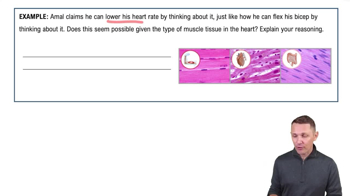
Introduction to Muscles and Muscle Tissue Example 1
14725
views
291
rank
4:36
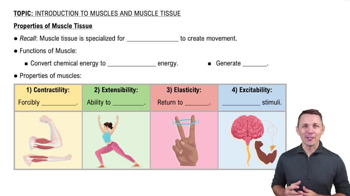
Properties of Muscle Tissue
22988
views
661
rank
2
comments
Termini in questo insieme (29)
Nascondere definizioni
What are the three types of muscle tissue?
Skeletal
,
Cardiac
, and
Smooth
muscle.
What prefixes are commonly used in muscle terminology?
Myo
,
mys
, and
sarco
.
Key characteristics of skeletal muscle tissue?
Long, cylindrical fibers with striations; voluntary control; contracts rapidly and powerfully.
Key characteristics of cardiac muscle tissue?
Found only in heart; striated; involuntary; contracts at steady rate due to pacemaker.
Key characteristics of smooth muscle tissue?
Found in walls of hollow organs; nonstriated; involuntary control.
Four main characteristics shared by all muscle tissue?
Excitability
,
Contractility
,
Extensibility
, and
Elasticity
.
Four important functions of muscle tissue?
Produce movement, maintain posture, stabilize joints, and generate heat.
What connective tissue sheaths surround skeletal muscle from external to internal?
Epimysium
surrounds entire muscle,
Perimysium
surrounds fascicles,
Endomysium
surrounds individual muscle fibers.
Difference between origin and insertion in muscle attachments?
Origin attaches to immovable bone; insertion attaches to movable bone.
What is a sarcomere?
Smallest contractile unit of muscle fiber, between two Z discs.
What proteins compose thick and thin filaments in muscle fibers?
Thick filaments are made of
myosin
; thin filaments are made of
actin
with regulatory proteins
troponin
and
tropomyosin
.
Role of titin in muscle fibers?
Elastic filament that holds thick filaments in place and helps recoil after stretch.
What causes Duchenne muscular dystrophy (DMD)?
Defective gene for
dystrophin
, leading to fragile sarcolemma and progressive muscle weakness.
Function of sarcoplasmic reticulum (SR) in muscle fibers?
Stores and releases
Ca2+
to regulate muscle contraction.
What are T tubules and their function?
Invaginations of sarcolemma that conduct electrical impulses deep into muscle fiber.
Explain the sliding filament model of muscle contraction.
Thin filaments slide past thick filaments, increasing overlap and shortening sarcomere without changing filament length.
Four steps of the cross bridge cycle?
Cross bridge formation, power stroke, cross bridge detachment, and cocking of myosin head.
What triggers muscle fiber excitation at the neuromuscular junction?
Release of acetylcholine (ACh) from motor neuron, binding to receptors on sarcolemma.
Describe the generation of an action potential in muscle fibers.
End plate potential causes depolarization by opening voltage-gated Na+ channels, followed by repolarization via K+ channels.
What is excitation-contraction coupling?
Process linking action potential propagation along sarcolemma to Ca2+ release from SR and muscle contraction.
How does Ca2+ regulate muscle contraction?
Ca2+ binds to troponin, moving tropomyosin to expose myosin-binding sites on actin.
What is muscle twitch and its three phases?
Single muscle fiber contraction with latent period, contraction phase, and relaxation phase.
Difference between isometric and isotonic contractions?
Isometric: muscle tension increases without shortening; isotonic: muscle shortens and moves load.
Three pathways for ATP regeneration in muscle contraction?
Direct phosphorylation by creatine phosphate, anaerobic glycolysis, and aerobic respiration.
What causes muscle fatigue?
Ionic imbalances, increased inorganic phosphate, decreased glycogen, and interference with Ca2+ release.
What is excess postexercise oxygen consumption (EPOC)?
Extra oxygen required to restore muscle to resting state after exercise.
Four factors affecting force of muscle contraction?
Number of fibers stimulated, fiber size, frequency of stimulation, and degree of muscle stretch.
Three types of skeletal muscle fibers based on contraction speed and metabolism?
Slow oxidative, fast oxidative, and fast glycolytic fibers.
Effects of aerobic vs resistance exercise on muscles?
Aerobic increases capillaries, mitochondria, and endurance; resistance causes hypertrophy and strength.
 IndietroIndietro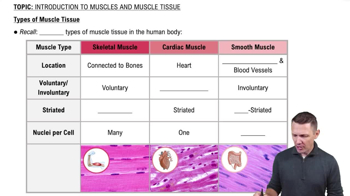
 6:31
6:31