 Indietro
Muscular System Fundamentals - Anatomy & Physiology
 6:31

Termini in questo insieme (22)
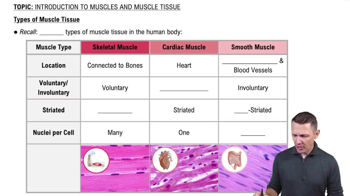
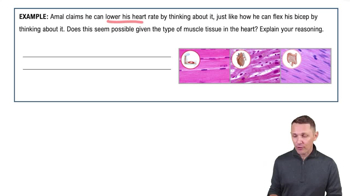
Skeletal (voluntary, striated, attached to bones), cardiac (involuntary, striated, heart), and smooth (involuntary, non-striated, walls of organs).
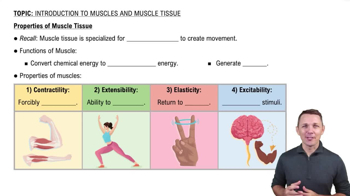
The muscular system consists of all muscles in the body that enable movement, maintain posture, and produce heat.
Endomysium surrounds individual muscle fibers, perimysium surrounds fascicles, and epimysium surrounds the entire muscle.
Tendon is a cord-like connective tissue attaching muscle to bone; aponeurosis is a broad, flat connective tissue serving the same function.
Composed of muscle fibers containing myofibrils with actin (thin) and myosin (thick) myofilaments responsible for contraction.
Myosin heads bind to actin filaments forming cross-bridges that pull actin to shorten the muscle fiber.
Triggered by a nerve impulse causing release of acetylcholine, leading to depolarization and an action potential in the muscle fiber.
Action potential triggers calcium release, enabling myosin-actin cross-bridge cycling and muscle shortening.
Variation in muscle contraction strength due to changes in stimulus frequency or number of fibers activated.
A sustained muscle contraction caused by rapid, repeated stimuli without relaxation.
Isotonic: muscle changes length to move load; isometric: muscle tension increases without changing length.
Continuous, partial contraction of muscles to maintain posture and readiness.
Creatine phosphate pathway, anaerobic glycolysis, and aerobic respiration.
Oxygen deficit is the extra oxygen needed after exercise; muscle fatigue is the inability to contract due to ATP depletion or lactic acid buildup.
Increases muscle endurance, capillary density, and mitochondrial number.
Increases muscle size (hypertrophy) and strength by enlarging muscle fibers.
Origin is the fixed attachment; insertion is the movable attachment of a muscle.
Prime mover: main muscle causing movement; antagonist: opposes movement; synergist: assists prime mover; fixator: stabilizes origin.
Include flexion, extension, abduction, adduction, rotation, and circumduction.
Based on location, shape, size, direction of fibers, number of origins, origin/insertion, and action.
Nerve supply enables contraction; exercise maintains muscle strength, tone, and health.
Decrease in muscle mass, strength, and endurance; increased fat infiltration and slower repair.