 Indietro
Nervous System Anatomy & Physiology
 0:50

Termini in questo insieme (23)
Intracranial regulation (ICR) refers to mechanisms or conditions that maintain a balance promoting an environment conducive to optimal brain functioning, regulating the contents of the skull including brain, circulatory system, and dura mater.
Sensory input: gathering information about internal and external changes.
Integration: processing and interpreting sensory input.
Motor output: activating effector organs to produce a response.
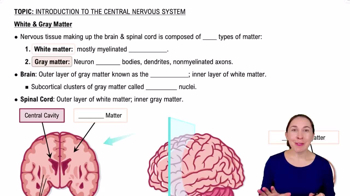
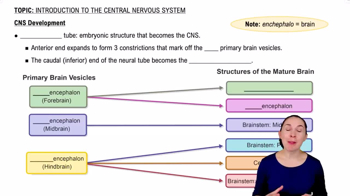
Central nervous system (CNS): brain and spinal cord.
Peripheral nervous system (PNS): nerves outside CNS, including cranial and spinal nerves.
Sensory (afferent) division: transmits impulses from receptors to CNS.
Motor (efferent) division: transmits impulses from CNS to effectors; includes somatic (voluntary) and autonomic (involuntary) systems.
Neurons: excitable cells that transmit electrical signals.
Neuroglia (glial cells): small cells that support and protect neurons.
Astrocytes: support, blood-brain barrier, homeostasis.
Microglial cells: immune defense, monitor neuron health.
Ependymal cells: line cavities, produce cerebrospinal fluid.
Oligodendrocytes: form myelin sheaths around CNS axons.
Satellite cells: surround neuron cell bodies.
Schwann cells: form myelin sheaths around peripheral nerve fibers and aid regeneration.
Myelin sheath protects and electrically insulates axons, increasing the speed of nerve impulse transmission.
Neurons have a cell body (biosynthetic center), dendrites (input regions), and a single axon (conducting region) that transmits impulses to axon terminals.
Multipolar: 3 or more processes.
Bipolar: 2 processes.
Unipolar: 1 short process.
Sensory (afferent): transmit impulses to CNS.
Motor (efferent): carry impulses from CNS to effectors.
Interneurons: connect sensory and motor neurons within CNS.
Approximately \(-70\,mV\), caused by ionic differences across the membrane and selective permeability.
Depolarization: membrane potential becomes less negative, increasing chance of nerve impulse.
Hyperpolarization: membrane potential becomes more negative, decreasing chance of nerve impulse.
Graded potentials: short-distance, variable strength signals.
Action potentials: long-distance, all-or-none nerve impulses.
Restores ionic conditions after repolarization by pumping Na+ out and K+ into the cell.
Absolute refractory period: neuron cannot respond to another stimulus.
Relative refractory period: neuron can respond only to a stronger stimulus.
Axon diameter (larger is faster) and degree of myelination (myelinated fibers conduct faster via saltatory conduction).
A junction where neurons communicate with other neurons or effector cells, either electrically or chemically.
Electrical synapses: direct cytoplasmic connections via gap junctions, fast but less common.
Chemical synapses: use neurotransmitters to transmit signals across synaptic clefts.
Chemical messengers of the nervous system; classified as biogenic amines, amino acids, purines, peptides, endocannabinoids, gases, and acetylcholine.
Channel-linked receptors: direct, fast synaptic transmission.
G protein-linked receptors: indirect, slow synaptic responses.
Input travels along one pathway to produce a specific, all-or-none response, such as spinal reflexes.
Input travels along multiple pathways simultaneously, allowing different responses to the same stimulus, important for higher mental functions.