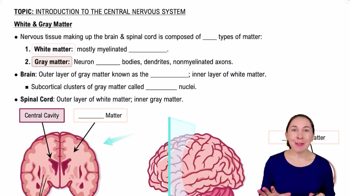
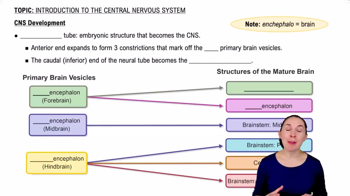
What are the two main structural divisions of the nervous system?
The Central Nervous System (CNS) consisting of the brain and spinal cord, and the Peripheral Nervous System (PNS) consisting of cranial nerves, spinal nerves, and their branches.
What are the three main functional divisions of the nervous system?
Sensory (afferent) division gathers information, Integrative functions analyze and interpret sensory input, and Motor (efferent) division carries out responses.
What is the difference between somatic and visceral sensory divisions?
The Somatic sensory division carries signals from skeletal muscles, bones, joints, and skin, including special senses. The Visceral sensory division carries signals from internal organs (viscera).
What are the two subdivisions of the motor (efferent) division of the PNS?
The Somatic motor division controls voluntary skeletal muscle contractions, and the Visceral motor division (Autonomic Nervous System) controls involuntary functions of smooth muscle, cardiac muscle, and glands.
What are neurons and neuroglia?
Neurons are excitable cells that send and receive signals. Neuroglia are smaller, more numerous cells that support, protect, and maintain the environment around neurons.
What are the three main functional regions of a neuron?
Receptive region (dendrites and cell body) receives signals, Conducting region (axon) transmits signals, and Secretory region (axon terminals) releases chemicals to target cells.
Describe the structural classification of neurons.
Multipolar neurons have one axon and multiple dendrites, bipolar neurons have one axon and one dendrite, and pseudounipolar neurons have a single axon that splits into two branches.
Where are multipolar, bipolar, and pseudounipolar neurons typically found?
Multipolar neurons are mostly in the CNS and motor neurons in the PNS; bipolar neurons are in special sensory organs like the retina; pseudounipolar neurons are sensory neurons in the PNS for touch, pain, and vibration.
What are nuclei, ganglia, tracts, and nerves in the nervous system?
Nuclei are clusters of neuron cell bodies in the CNS, ganglia are clusters in the PNS, tracts are bundles of axons in the CNS, and nerves are bundles of axons in the PNS.
Name the six types of neuroglia and their locations.
In the CNS: Astrocytes, oligodendrocytes, microglia, ependymal cells. In the PNS: Neurolemmocytes (Schwann cells) and satellite cells.
What are the main functions of astrocytes?
Astrocytes anchor neurons and blood vessels, facilitate nutrient and gas transport, remove excess ions and neurotransmitters, assist in blood-brain barrier formation, and repair damaged brain tissue.
What role do oligodendrocytes play in the CNS?
Oligodendrocytes form the myelin sheath by wrapping plasma membrane layers around axons, increasing the speed of nerve impulse conduction.
What is the function of microglia?
Microglia are phagocytic cells that ingest pathogens, dead neurons, and debris, and stimulate inflammation in response to brain injury.
What do ependymal cells do?
Ependymal cells line brain and spinal cord cavities, circulate cerebrospinal fluid (CSF), and monitor its composition.
What are the functions of neurolemmocytes (Schwann cells) in the PNS?
Neurolemmocytes encase axons, form myelin sheaths, and assist in the repair of damaged axons.
What is the myelin sheath and its significance?
The myelin sheath is a multilayered lipid and protein coating around axons formed by oligodendrocytes in the CNS and Schwann cells in the PNS, which insulates axons and speeds up action potential conduction.
What is the difference between continuous and saltatory conduction?
Continuous conduction occurs in unmyelinated axons where every segment depolarizes, making it slower. Saltatory conduction occurs in myelinated axons where action potentials jump between nodes of Ranvier, making it faster and more efficient.
What is the resting membrane potential of a neuron and why is it negative?
The resting membrane potential is about -70 mV, negative because of the constant loss of positively charged potassium ions through leak channels, creating a polarized membrane.
What are the four types of ion channels in neurons?
Leak channels (always open), ligand-gated channels (open with ligand binding), voltage-gated channels (open with voltage changes), and mechanically gated channels (open with mechanical deformation).
Describe the sodium-potassium pump function.
The pump uses ATP to move 3 sodium ions out of the cell and 2 potassium ions into the cell, maintaining concentration gradients essential for the resting membrane potential.
Define depolarization, repolarization, and hyperpolarization.
Depolarization is when the membrane potential becomes less negative due to cation influx. Repolarization is the return to resting potential. Hyperpolarization is when the membrane potential becomes more negative than resting.
What is an action potential?
An action potential is a rapid, uniform depolarization and repolarization of the neuron's membrane that transmits a signal along the axon.
What are the states of voltage-gated sodium channels during an action potential?
The refractory period is the time after an action potential when the neuron cannot fire another. It has an absolute phase (no stimulus can trigger) and a relative phase (a stronger stimulus can trigger).
How do local potentials differ from action potentials?
Local potentials are graded, reversible, and decremental, while action potentials are all-or-none, irreversible, and nondecremental.
What factors influence the conduction speed of action potentials?
Conduction speed is influenced by axon diameter (larger is faster) and presence of myelin sheath (myelinated axons conduct faster).
What is multiple sclerosis and how does it affect neurons?
Multiple sclerosis is an autoimmune disease where the immune system attacks CNS myelin, causing loss of myelin, impaired nerve conduction, and symptoms like sensory changes and paralysis.
What is a synapse and what are the types of neuronal synapses?
A synapse is the junction where a neuron communicates with another cell. Types include axodendritic, axosomatic, and axoaxonic synapses.
What are excitatory and inhibitory postsynaptic potentials?
Excitatory postsynaptic potentials (EPSPs) depolarize the postsynaptic membrane, moving it closer to threshold. Inhibitory postsynaptic potentials (IPSPs) hyperpolarize it, moving it farther from threshold.
 Indietro
 0:50
0:50