Skip to main content
Anatomy & Physiology
Il mio corso
Impara
Preparazione agli esami
AI Tutor
Guide di studio
Soluzioni per libri di testo
Flashcard
Esplora
Prova l'app
Il mio corso
Impara
Preparazione agli esami
AI Tutor
Guide di studio
Soluzioni per libri di testo
Flashcard
Esplora
Prova l'app
Indietro
Neural Tissue and Neuron Structure - Anatomy & Physiology
Puoi toccare per girare la carta.
What are the two main types of cells in nervous tissue?
Puoi toccare per girare la carta.
👆
What are the two main types of cells in nervous tissue?
Neurons
and
Neuroglia cells
.
Avanzamenti del tracciato
I pulsanti di controllo sono stati cambiati in modalità "navigazione".
1/20
Video consigliati
04:36
Intro to Nervous Tissue
7891
views
152
rank
Termini in questo insieme (20)
Nascondere definizioni
What are the two main types of cells in nervous tissue?
Neurons
and
Neuroglia cells
.
What is the primary function of neurons?
To generate and transmit messages as nerve impulses or neuronal action potentials.
What are neuroglia cells and their main role?
Smaller cells that outnumber neurons about 50 to 1; they support and protect neurons.
What is the cell body (soma) of a neuron?
The biosynthetic center containing the nucleus, nucleolus, mitochondria, Golgi apparatus, and Nissl bodies.
What are Nissl bodies in neurons?
Clusters of free ribosomes in the cytoplasm involved in protein synthesis.
What are the two types of processes extending from the neuron cell body?
Dendrites
(receive impulses) and
Axons
(transmit impulses).
What is the function of dendrites?
To receive impulses from other neurons.
What is the axon hillock?
The region where the axon emerges from the cell body and where nerve impulses are generated.
What are telodendria?
Branches at the end of an axon that end in synaptic terminals or synaptic knobs.
What is the role of Schwann cells in the PNS?
They cover individual axons with myelin, insulating them and speeding nerve impulse conduction.
What do satellite cells do in the PNS?
Surround and protect the cell bodies of neurons.
What is the function of astrocytes in the CNS?
They connect neurons to blood vessels and maintain the blood-brain barrier.
What is the role of oligodendrocytes?
They myelinate multiple axons of CNS neurons.
What are microglial cells?
Phagocytic cells that protect neurons by removing debris and pathogens.
What do ependymal cells do?
Line brain and spinal cord cavities, secrete and circulate cerebrospinal fluid.
What is a synapse?
The site where a nerve cell and another cell (e.g., muscle) communicate.
What are the components of the neuromuscular junction?
Presynaptic terminal with acetylcholine vesicles, synaptic cleft, and postsynaptic membrane (motor end plate) with receptors.
What is the presynaptic terminal?
The axon terminal containing synaptic vesicles filled with acetylcholine.
What is the synaptic cleft?
The space between the presynaptic terminal and the postsynaptic membrane.
What is the motor end plate?
The postsynaptic membrane of the muscle cell with acetylcholine receptors.
 IndietroIndietro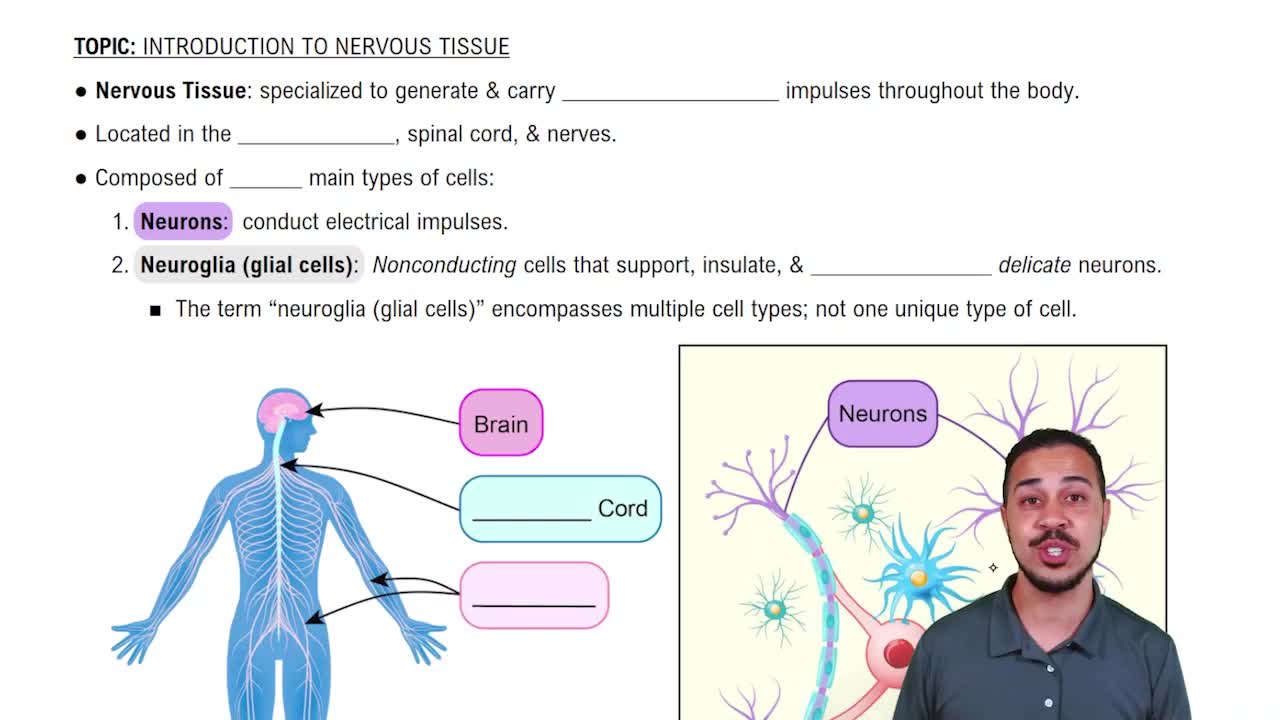
 04:36
04:36