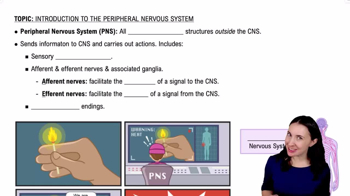
The PNS is all neural structures outside the brain and spinal cord, serving as the communication link between the CNS and the external/internal environment.
What are the two main divisions of the PNS?
The sensory (afferent) division transmits sensory info to the CNS, and the motor (efferent) division carries motor commands from the CNS to effectors.
What are the subdivisions of the motor (efferent) division?
Somatic nervous system controls voluntary movements; autonomic nervous system regulates involuntary functions and is subdivided into sympathetic and parasympathetic divisions.
What are mechanoreceptors?
Sensory receptors that respond to touch, pressure, vibration, and stretch.
What type of stimuli do thermoreceptors detect?
Thermoreceptors are sensitive to temperature changes.
What are photoreceptors specialized for?
Photoreceptors respond to light energy, such as those in the retina.
Define chemoreceptors.
Chemoreceptors respond to chemical stimuli like smell, taste, and blood chemistry.
What stimuli activate nociceptors?
Nociceptors detect pain-causing stimuli such as extreme heat, cold, pressure, or chemicals.
How are sensory receptors structurally classified?
They are simple (general senses) or complex (special senses); simple receptors include nonencapsulated and encapsulated types.
What are nonencapsulated (free) nerve endings?
Modified dendritic endings found in epithelia and connective tissue that detect tactile sensations, temperature, pain, and muscle sense.
What are encapsulated nerve endings?
Dendritic endings enclosed in connective tissue capsules, mostly mechanoreceptors.
What are the three levels of neural integration in sensory processing?
Receptor level (sensory receptors generate graded potentials), circuit level (neurons transmit signals to cortex), and perceptual level (identification and interpretation of stimuli).
What is the difference between phasic and tonic receptors?
Phasic receptors adapt quickly and signal at stimulus start/end; tonic receptors adapt slowly or not at all, maintaining response.
What causes visceral pain and how is it perceived?
Visceral pain arises from stimulation of visceral organ receptors and is often felt as vague aching or burning.
What is referred pain?
Pain perceived in a region different from its source due to shared nerve pathways between visceral and somatic fibers.
How are nerves structurally organized?
Nerves are bundles of myelinated and nonmyelinated peripheral axons enclosed by connective tissue.
What are the classifications of nerves by function?
Sensory (afferent) nerves carry info to the brain, motor (efferent) nerves carry commands from the brain, and mixed nerves contain both sensory and motor fibers.
What are ganglia?
Clusters of neuron cell bodies in the PNS; afferent ganglia contain sensory neuron bodies, efferent ganglia contain autonomic motor neuron bodies.
How many pairs of cranial nerves are there and what is their general function?
There are 12 pairs; most are mixed nerves serving sensory and motor functions for head and neck.
What is the function of the vagus nerve (cranial nerve X)?
It regulates heart, lungs, and abdominal viscera and is the only cranial nerve extending beyond the head and neck.
How many pairs of spinal nerves are there and what is their composition?
31 pairs of mixed spinal nerves supply the body except the head and part of the neck.
What are the main branches of a spinal nerve after exiting the vertebral foramen?
An interlacing network of ventral rami that innervates limbs, providing redundancy and protection against paralysis.
Name the four major nerve plexuses and their general innervation areas.
Cervical (neck and shoulders), brachial (upper limb), lumbar (thigh and abdominal wall), sacral (buttock, lower limb, pelvic structures).
What nerves supply the anterolateral thorax and abdominal wall?
Intercostal nerves (ventral rami of T1-T12) supply muscles and skin without forming a plexus.
What is the key equation for converting graded potentials to action potentials?
If graded potential (GP) is greater than or equal to threshold, then an action potential (AP) is generated: \(\text{If GP} \geq \text{threshold} \rightarrow \text{AP}\)
 Indietro
 1:06