 Indietro
pH, Acids, Bases, and Buffers in Anatomy & Physiology
 01:54

Termini in questo insieme (20)
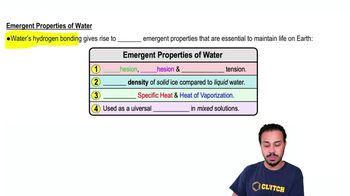
Specific heat is the amount of heat needed to raise the temperature of 1 g of a substance by 1°C. Water's high specific heat (4.186 J/g°C) helps stabilize temperatures in living organisms and environments.
Hydrogen bonds absorb heat when they break and release heat when they form, giving water a high specific heat that resists temperature changes.
Evaporative cooling occurs when liquid water evaporates, cooling the surface left behind. It helps stabilize temperatures in organisms and bodies of water.
Ice floats because hydrogen bonds form a stable, ordered crystal structure that makes ice less dense than liquid water, which is densest at 4°C.
If ice sank, bodies of water would freeze solid from the bottom up, making life impossible in aquatic environments.
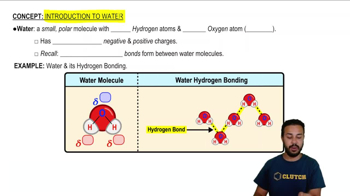
A solvent dissolves substances, a solute is dissolved, and a solution is a homogeneous mixture. Water is a versatile solvent due to its polarity.
A hydration shell is a sphere of water molecules surrounding each ion when an ionic compound dissolves in water.
Electrolytes are ions that conduct electrical currents in solution, essential for body functions like nerve impulses and muscle contraction.
Hydrophilic substances have an affinity for water and dissolve easily, while hydrophobic substances repel water and do not dissolve well.
Acids are proton donors that release H+ ions; bases are proton acceptors that pick up H+ ions or release OH- ions.
Important acids: hydrochloric acid (HCl), acetic acid, carbonic acid. Important bases: bicarbonate ion, ammonia.
It dissociates completely into H+ and Cl- ions, increasing the hydrogen ion concentration.
NaOH dissociates completely to release OH- ions, which combine with H+ ions to form water, reducing acidity.
The pH scale measures hydrogen ion concentration; lower pH is acidic, higher pH is basic, and 7 is neutral.
Most biological fluids have a pH between 6 and 8, maintaining homeostasis.
A neutralization reaction occurs when an acid and a base mix to form water and a salt, balancing pH.
Buffers resist large pH changes by releasing H+ ions if pH rises or binding H+ ions if pH falls, maintaining stable conditions.
The bicarbonate buffer system converts strong acids or bases into weaker ones, helping maintain blood pH balance.
Enzymes work optimally within a narrow pH range; deviations can impair function and affect survival.
An arterial pH below 6.85 or around 7.0 during resuscitation predicts poor patient outcomes due to enzyme dysfunction.