 Indietro
Physiology Ch. 20 exam review
 4:06

Termini in questo insieme (28)
To obtain fuel molecules for energy, raw materials as building blocks, essential nutrients like vitamins and minerals, and water.
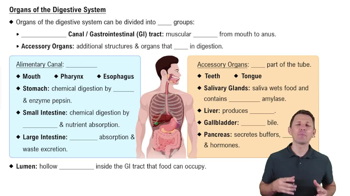
A continuous tube from mouth to anus including the mouth, pharynx, esophagus, stomach, small intestine, and large intestine.
Organs like the salivary glands, liver, gallbladder, and pancreas that secrete substances into the GI tract but are not part of the continuous tube.
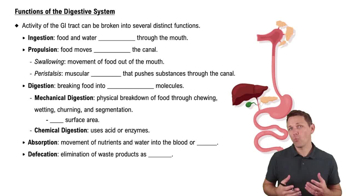
Physical breakdown of large food particles into smaller pieces without breaking chemical bonds, e.g., chewing and stomach contractions.
Breaking covalent bonds in food molecules to form smaller molecules, e.g., enzymatic breakdown of starch or proteins.
The process of moving nutrients from the lumen of the GI tract across the epithelial lining into blood vessels or lymphatics.
Movement of fluids and enzymes from the internal body environment into the lumen of the GI tract to aid digestion.
Muscular movement of food through the GI tract, usually from mouth to anus, including peristalsis and segmentation.
Villi are small finger-like projections in the small intestine increasing surface area; microvilli are tiny projections on absorptive cells further increasing surface area.
They form the epithelial lining of villi and regulate nutrient absorption from the lumen into the internal body environment.
Via secondary active transport with sodium on the apical side and facilitated diffusion on the basal side into blood capillaries.
Because they must be broken down into amino acids or small peptides to avoid immune reactions and to be properly used by the body.
Peptidases, including pepsin in the stomach and pancreatic peptidases in the small intestine, break peptide bonds.
By secondary active transport with sodium on the apical side and facilitated diffusion on the basal side, similar to glucose absorption.
The process where bile salts break large fat globules into smaller droplets to increase surface area for lipase action.
Amphipathic molecules produced by the liver that emulsify fats, aiding their digestion in the small intestine.
Lipids diffuse through the absorptive cell membrane, are reassembled into triglycerides, packaged into chylomicrons, and enter lymphatic lacteals.
Lipoprotein particles that transport reassembled lipids through lymphatic vessels to the bloodstream.
Vitamins are absorbed as they are, without chemical digestion, using various transport mechanisms depending on the vitamin.
By osmosis following the absorption of solutes like sodium, amino acids, and minerals, mainly in the small and large intestines.
Secrete saliva containing water, amylase, lysozyme, bicarbonate, and mucus to moisten food, begin starch digestion, and protect the mouth.
Mechanical digestion by churning, chemical digestion of proteins by pepsin, and producing acidic gastric juice to denature proteins and kill bacteria.
Produces bile for fat emulsification, removes old red blood cells, synthesizes plasma proteins, and detoxifies wastes.
Stores and concentrates bile, releasing it into the small intestine upon stimulation by cholecystokinin.
Secretes pancreatic juice containing digestive enzymes and bicarbonate into the small intestine to aid digestion and neutralize stomach acid.
Wave-like muscular contractions that move food or chyme through the GI tract in one direction.
Muscular contractions that mix chyme by pushing it back and forth, enhancing contact with absorptive surfaces in the intestines.
They aid digestion, produce some vitamins, and maintain gut health in a symbiotic relationship with the host.