Skip to main content
Anatomy & Physiology
Il mio corso
Impara
Preparazione agli esami
AI Tutor
Guide di studio
Soluzioni per libri di testo
Flashcard
Esplora
Prova l'app
Il mio corso
Impara
Preparazione agli esami
AI Tutor
Guide di studio
Soluzioni per libri di testo
Flashcard
Esplora
Prova l'app
Indietro
Physiology Ch. 3 Exam review
Puoi toccare per girare la carta.
What are reactants and products in a chemical reaction?
Puoi toccare per girare la carta.
👆
What are reactants and products in a chemical reaction?
Reactants are substances on the left side of the equation that are transformed into products, which are on the right side.
Avanzamenti del tracciato
I pulsanti di controllo sono stati cambiati in modalità "navigazione".
1/30
Video consigliati
VideoThumbView.guidedCourse
01:56
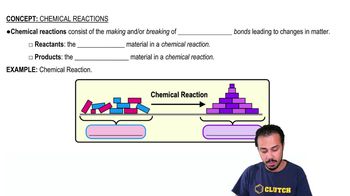
Chemical Reactions
23873
views
398
rank
VideoThumbView.guidedCourse
05:48
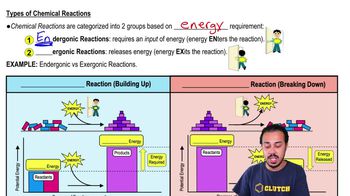
Types of Chemical Reactions
22186
views
313
rank
1
comments
Termini in questo insieme (30)
Nascondere definizioni
What are reactants and products in a chemical reaction?
Reactants are substances on the left side of the equation that are transformed into products, which are on the right side.
Define metabolism.
Metabolism is the sum of all chemical reactions inside cells, including catabolic (breakdown) and anabolic (building) reactions.
Difference between catabolic and anabolic reactions.
Catabolic reactions break down molecules and release energy (ΔG negative). Anabolic reactions build molecules and require energy (ΔG positive).
What happens in hydrolysis and condensation reactions?
Hydrolysis adds water to break covalent bonds (catabolic). Condensation removes water to form covalent bonds (anabolic).
Explain phosphorylation and dephosphorylation.
Phosphorylation adds a phosphate group to a molecule, often catalyzed by kinases. Dephosphorylation removes it, catalyzed by phosphatases.
What is an oxidation-reduction (redox) reaction?
Oxidation is loss of electrons or hydrogen atoms; reduction is gain of electrons or hydrogen atoms. They always occur together.
State the first law of thermodynamics.
Energy can be transformed from one form to another but cannot be created or destroyed.
State the second law of thermodynamics.
Natural processes increase disorder; some energy is lost as heat and is unusable for work.
What are the three types of work performed by cells?
Chemical work (anabolic reactions), transport work (active transport), and mechanical work (muscle contraction, cilia movement).
Describe coupled reactions involving ATP.
Energy from exergonic catabolic reactions is stored in ATP, which then drives endergonic anabolic reactions.
What is chemical equilibrium in reactions?
When forward and reverse reaction rates are equal, ΔG = 0, no net work is done, and the cell tries to avoid this state.
Explain the law of mass action.
Increasing reactant concentration pushes reactions forward; increasing product concentration pushes reactions backward.
What limits the speed of a chemical reaction?
The activation energy barrier limits reaction speed; higher activation energy means slower reaction.
How do enzymes affect activation energy?
Enzymes lower the activation energy, speeding up the reaction without being consumed.
What is substrate specificity of enzymes?
Enzymes bind only specific substrates due to the shape of their active site.
Describe the induced fit model of enzyme action.
The enzyme changes shape slightly to fit the substrate, straining bonds and lowering activation energy.
What roles do cofactors and coenzymes play in enzyme function?
Cofactors are inorganic ions stabilizing the active site; coenzymes are organic molecules that transfer chemical groups or electrons.
How does substrate concentration affect enzyme activity?
Increasing substrate concentration increases reaction rate until enzymes become saturated.
What happens to enzyme activity at temperatures above optimal?
Enzymes denature, active site shape changes, and reaction rate decreases.
What is allosteric regulation of enzymes?
Modulators bind to a site other than the active site, changing enzyme shape and activity; inhibitors decrease and activators increase activity.
Explain feedback inhibition in metabolic pathways.
An intermediate or end-product inhibits an earlier enzyme in the pathway, slowing product formation.
What is glycolysis and where does it occur?
Glycolysis is the breakdown of glucose into two pyruvate molecules, producing ATP and NADH; it occurs in the cytosol.
What happens during formation of acetyl CoA?
Pyruvate is converted to acetyl CoA in the mitochondrial matrix, producing NADH and releasing CO2.
Outline the citric acid (Kreb’s) cycle products.
Each glucose yields 6 NADH, 2 FADH2, 2 ATP, and 4 CO2 through the cycle in the mitochondrial matrix.
Describe the electron transport chain (ETC) and oxidative phosphorylation.
ETC transfers electrons from NADH/FADH2 to oxygen, pumping H+ to create a gradient used by ATP synthase to make ATP.
What is chemiosmosis?
The flow of protons down their concentration gradient through ATP synthase, driving ATP production.
Why do cells perform fermentation?
When oxygen is absent or mitochondria are overwhelmed, fermentation regenerates NAD+ by converting pyruvate to lactate or ethanol.
Define glycogenesis, glycogenolysis, and gluconeogenesis.
Glycogenesis: glycogen synthesis; glycogenolysis: glycogen breakdown; gluconeogenesis: new glucose production from non-carbohydrates.
What is lipolysis and lipogenesis?
Lipolysis is the breakdown of lipids for energy; lipogenesis is the synthesis of lipids for storage.
What is proteolysis and why is it harmful as an energy source?
Proteolysis is protein breakdown; using proteins for energy produces ammonia, which can harm liver and kidneys.
 IndietroIndietro
 01:56