What are the basic components of the cell membrane?
The cell membrane is composed of the phospholipid bilayer, cholesterol (a steroid made in the smooth ER), and proteins associated with the membrane.
What is the Fluid Mosaic Model of the cell membrane?
The Fluid Mosaic Model describes the membrane as fluid because phospholipids move, and a mosaic because it contains cholesterol, proteins, and carbohydrates.
Which substances cannot move on their own through the cell membrane?
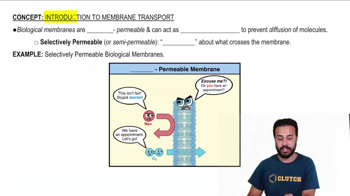
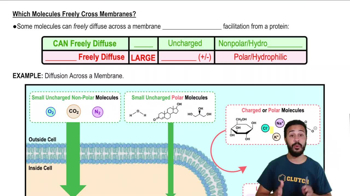
Hydrophilic or large substances like proteins, carbohydrates, nucleic acids, all ions (e.g., Na+, K+, Ca2+), and triglycerides cannot cross the membrane without help.
Which substances can move on their own through the cell membrane?
Hydrophobic or small substances such as gases (O2, CO2), steroids, carotenoids, eicosanoids, and water can move via simple diffusion.
What is simple diffusion?
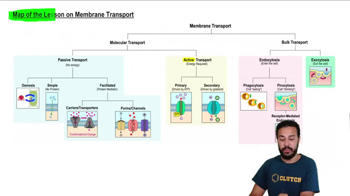
Simple diffusion is the passive movement of substances down their concentration gradient (from high to low concentration) without assistance.
What is facilitated diffusion?
Facilitated diffusion moves substances down their gradient with the help of carrier or channel proteins when they cannot cross the membrane alone.
How does active transport differ from facilitated diffusion?
Active transport moves substances against their gradient (low to high) using carrier proteins and requires energy (ATP), unlike facilitated diffusion.
What is osmosis?
Osmosis is the passive diffusion of water across a membrane from an area of higher water concentration to lower water concentration.
What role do aquaporins play in water transport?
Aquaporins are large channel proteins that allow rapid water movement across membranes while excluding ions, facilitating osmosis.
Define tonicity and how it differs from osmolarity.
Tonicity compares solute concentration between two solutions (inside vs. outside cell) affecting cell volume, while osmolarity is the total solute concentration of a solution.
What factors affect the rate of simple diffusion?
Rate depends on magnitude of driving force (electrochemical gradient), membrane surface area, and membrane permeability.
What factors affect the rate of facilitated diffusion?
Rate depends on transport rate of carriers/channels, number of carriers/channels, and magnitude of electrochemical gradient.
What is the difference between a carrier protein and a channel protein?
Carriers bind and change shape to move ligands, possibly bidirectionally; channels form pores allowing specific substances to pass through without shape change.
What is primary active transport?
Primary active transport uses ATP directly to move substances against their gradient, e.g., the Na+/K+ pump.
How does the Na+/K+ pump work?
It pumps 3 Na+ out and 2 K+ in per ATP hydrolyzed, creating ion gradients and membrane voltage.
What is secondary active transport?
Secondary active transport uses the energy from an ion moving down its gradient (created by primary active transport) to move another substance against its gradient.
How do primary and secondary active transport relate?
Primary active transport creates ion gradients (voltage), which secondary active transporters use as an energy source to move other molecules.
What factors affect the rate of active transport?
Rate depends on the rate of individual pumps and the number of pumps in the membrane.
What is bulk transport?
Bulk transport moves large molecules or quantities via vesicles, including exocytosis (out) and endocytosis (in).
 Indietro
 02:26