Skip to main content
Anatomy & Physiology
Il mio corso
Impara
Preparazione agli esami
AI Tutor
Guide di studio
Soluzioni per libri di testo
Flashcard
Esplora
Prova l'app
Il mio corso
Impara
Preparazione agli esami
AI Tutor
Guide di studio
Soluzioni per libri di testo
Flashcard
Esplora
Prova l'app
Indietro
Renal Physiology - Anatomy & Physiology
Puoi toccare per girare la carta.
Primary functions of the kidney
Puoi toccare per girare la carta.
👆
Primary functions of the kidney
Excretion of wastes and foreign chemicals, and regulation of body fluid volume and electrolyte composition.
Avanzamenti del tracciato
I pulsanti di controllo sono stati cambiati in modalità "navigazione".
1/29
Video consigliati
0:54
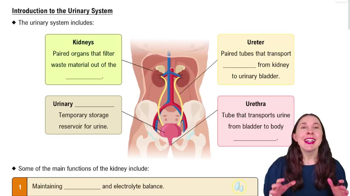
Introduction to the Urinary System Example 1
6308
views
172
rank
2:57
The Urinary System
8351
views
245
rank
2
comments
Termini in questo insieme (29)
Nascondere definizioni
Primary functions of the kidney
Excretion of wastes and foreign chemicals, and regulation of body fluid volume and electrolyte composition.
Role of ADH in water regulation
ADH increases aquaporin insertion in collecting ducts, enhancing water reabsorption and producing concentrated urine during dehydration.
Countercurrent multiplier mechanism
Loop of Henle recaptures NaCl and urea via opposite flow in limbs, creating a medullary osmotic gradient for urine concentration.
Countercurrent exchanger function
Vasa recta capillaries exchange water and salts to maintain medullary osmolarity while removing reabsorbed water.
Range of urine osmolarity
Collecting duct can produce urine from 50 mOsm/L (dilute) to 1,200 mOsm/L (concentrated) depending on hydration.
Extracellular fluid volume control
Regulated mainly by kidney control of sodium and water input/output, influenced by GFR and tubular sodium reabsorption.
Renal mechanisms for acid-base balance
Secretion of H+, reabsorption of filtered HCO3−, and production of new HCO3− to maintain blood pH.
Sites of H+ secretion and HCO3− reabsorption
Occurs mainly in proximal tubule (80-90%), thick ascending limb (10%), and distal tubules/collecting ducts.
Process of H+ secretion in tubules
Na+-H+ exchanger secretes H+ into lumen; H+ combines with HCO3− forming CO2 and water, which diffuse back into cells.
Role of Type A intercalated cells
Actively secrete H+ in late distal tubules and collecting ducts to acidify urine and excrete acid.
Phosphate buffer system in urine
H+ combines with HPO42− to form H2PO4−, which is excreted, aiding acid excretion and new HCO3− formation.
Ammonia buffer system
Glutamine metabolism produces NH4+ and new HCO3−; NH4+ is secreted in exchange for Na+ and excreted, aiding acid removal.
Micturition process
Urinary bladder empties via rise in wall tension and micturition reflex involving detrusor contraction and sphincter relaxation.
Innervation of the urinary bladder
Parasympathetic pelvic nerves stimulate detrusor; pudendal nerve controls external sphincter; sympathetic hypogastric nerves modulate sensation.
Micturition reflex pathway
Stretch receptors send afferent signals to spinal cord; efferent parasympathetic fibers cause detrusor contraction and sphincter relaxation.
Higher brain centers' role in micturition
Inhibit or facilitate reflex; maintain external sphincter tone; allow voluntary control of urination.
Acute kidney injury (AKI) categories
Prerenal (blood flow issues), intrarenal (kidney tissue damage), and postrenal (urinary tract obstruction).
Causes of prerenal AKI
Heart problems or low blood volume causing reduced renal blood flow and possible reversible oliguria.
Intrarenal AKI causes
Damage to glomeruli, renal tubules (e.g., tubular necrosis), or interstitium from ischemia, toxins, or infections.
Postrenal AKI causes
Obstruction in urinary tract such as renal stones, clots, bladder or urethral blockage.
Physiological effects of AKI
Retention of water, wastes, electrolytes; edema; hyperkalemia; metabolic acidosis; possible fatal anuria.
Chronic kidney disease (CKD) definition
Progressive loss of kidney function over 3+ months with nephron loss and risk of end-stage renal disease.
Common causes of CKD
Diabetes mellitus, hypertension, glomerulonephritis, polycystic kidney disease, and vascular diseases.
Nephrotic syndrome
Proteinuria due to increased glomerular permeability, often linked to chronic glomerulonephritis or amyloidosis.
Renal function tests by clearance
Measurement of glomerular filtration rate (GFR) and renal plasma flow (RPF) using clearance of substances.
Urinalysis components
Physical, microscopic, and chemical examination to detect abnormalities like proteinuria, hematuria, infection.
Blood tests for kidney function
Plasma protein levels, urea, uric acid, and creatinine concentrations indicate renal health.
Principle of renal dialysis
Blood passes through membranes allowing diffusion of wastes into dialysate, removing toxins and excess substances.
Dialyzing fluid composition
Adjusted to remove urea, creatinine, and other wastes while maintaining electrolyte balance during dialysis.
 IndietroIndietro
 0:54
0:54