Indietro

Skeletal and Muscular System Basics

I pulsanti di controllo sono stati cambiati in modalità "navigazione".
1/15
  • What components make up the skeletal system?

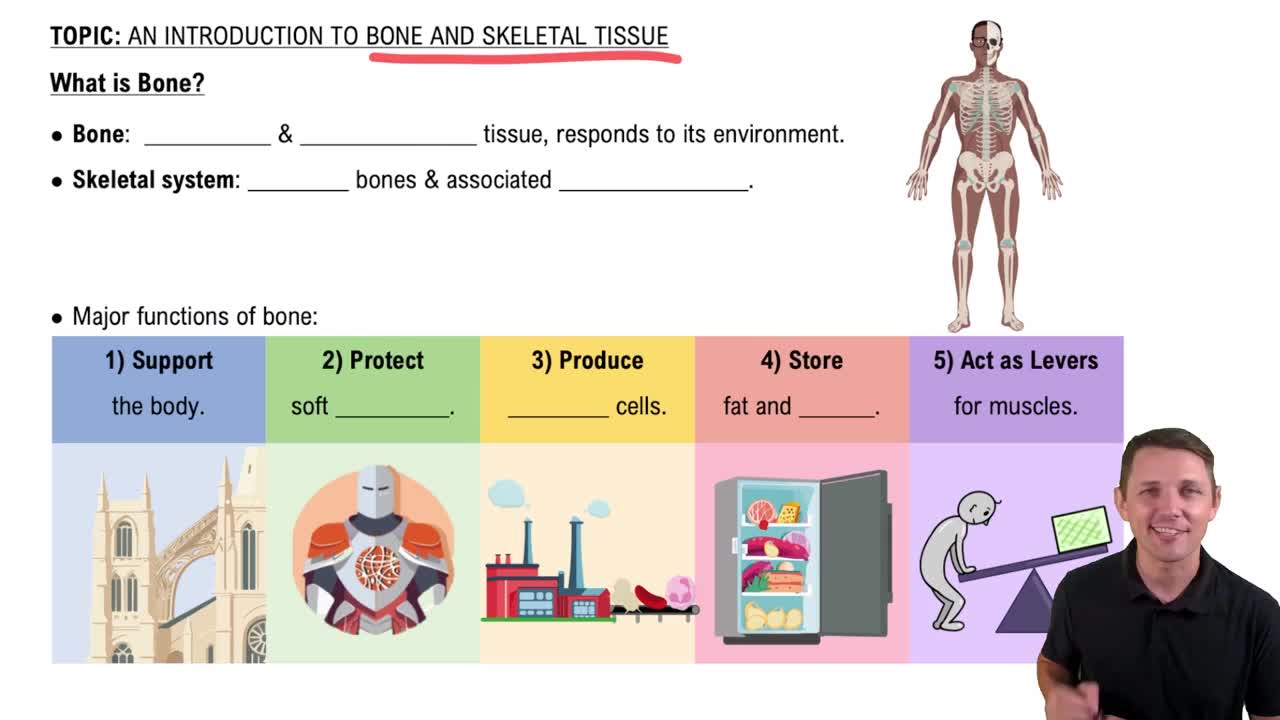
    The skeletal system includes bones, joints, cartilages, and ligaments.
  • What are ligaments?

    Ligaments are fibrous cords that bind bones together at joints.
  • How is the skeleton divided?

    The skeleton is divided into the axial skeleton and the appendicular skeleton.
  • What bones form the axial skeleton?

    The axial skeleton consists of bones forming the longitudinal axis of the body.
  • What bones form the appendicular skeleton?

    The appendicular skeleton includes the bones of the limbs and girdles attaching them to the axial skeleton.
  • What role do joints play in the skeletal system?

    Joints provide flexibility and allow movement between bones.
  • Why are bones essential for body shape and movement?

    Without bones, the body would lack definite shape and form and could not move properly.
  • What is the essential function of muscle tissue?

    Muscle tissue contracts or shortens, enabling body movement.
  • What distinguishes muscle tissue from other body tissues?

    Muscle tissue's unique ability to contract sets it apart from other tissues.
  • What are skeletal muscles?

    Skeletal muscles are organs made of skeletal muscle fibers that attach to the skeleton.
  • How do skeletal muscles contribute to body shape?

    Skeletal muscles cover bones and cartilage, helping form the smooth contours of the body.
  • Besides movement, what are three other important roles of skeletal muscle?

    Skeletal muscle maintains posture, stabilizes joints, and generates heat.
  • What is the relationship between skeletal muscles and bones?

    Skeletal muscles attach to bones and produce movement by contracting.
  • What is the function of cartilages in the skeletal system?

    Cartilages provide flexible support and reduce friction at joints.
  • How do muscles act as the 'machines' of the body?

    Muscles generate movement by contracting, enabling all body motions.