Skip to main content
Anatomy & Physiology
Il mio corso
Impara
Preparazione agli esami
AI Tutor
Guide di studio
Soluzioni per libri di testo
Flashcard
Esplora
Prova l'app
Il mio corso
Impara
Preparazione agli esami
AI Tutor
Guide di studio
Soluzioni per libri di testo
Flashcard
Esplora
Prova l'app
Indietro
The Cell - Anatomy & Physiology
Puoi toccare per girare la carta.
What are the three basic components of most animal cells?
Puoi toccare per girare la carta.
👆
What are the three basic components of most animal cells?
Plasma membrane
,
cytoplasm
(including cytosol, organelles, cytoskeleton), and
nucleus
.
Avanzamenti del tracciato
I pulsanti di controllo sono stati cambiati in modalità "navigazione".
1/20
Video consigliati
VideoThumbView.guidedCourse
04:26
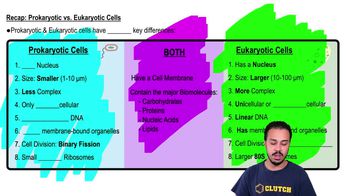
Recap: Prokaryotic vs. Eukaryotic Cells
24481
views
419
rank
VideoThumbView.guidedCourse
05:54
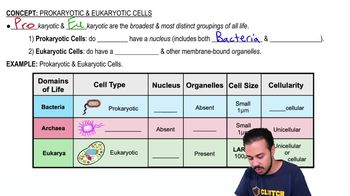
Prokaryotic & Eukaryotic Cells
40695
views
895
rank
2
comments
VideoThumbView.guidedCourse
03:54
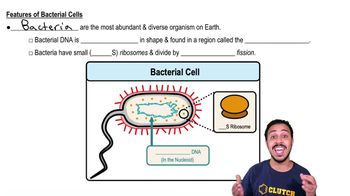
Features of Bacterial Cells
29714
views
524
rank
Termini in questo insieme (20)
Nascondere definizioni
What are the three basic components of most animal cells?
Plasma membrane
,
cytoplasm
(including cytosol, organelles, cytoskeleton), and
nucleus
.
What is the structure of the plasma membrane?
A
phospholipid bilayer
with hydrophilic polar phosphate heads facing water and hydrophobic nonpolar fatty acid tails facing inward.
What is the fluid mosaic model of the plasma membrane?
A model describing the membrane as a fluid combination of phospholipids, cholesterol, and proteins that move laterally within the layer.
Name the main functions of membrane proteins.
Channels, carriers, receptors, enzymes, structural support, and linking adjacent cells.
What determines the type of transport across the plasma membrane?
The substance type, membrane permeability, and concentration gradient inside and outside the cell.
What is passive transport?
Movement of substances across the membrane without energy, including diffusion, facilitated diffusion, and osmosis.
What is active transport?
Energy-requiring transport moving solutes against their concentration gradient using carrier proteins called pumps.
Describe primary active transport.
Direct use of ATP to transport molecules against their concentration gradient, e.g., the Na+/K+ pump.
Describe secondary active transport.
Uses the energy from one molecule moving down its gradient to transport another molecule against its gradient.
What is vesicular transport?
Transport of large particles or fluids using vesicles, including endocytosis (phagocytosis, pinocytosis) and exocytosis.
What is phagocytosis?
A form of endocytosis where cells ingest large particles like bacteria or dead cells, performed by phagocytes.
What is the function of mitochondria?
Produce most of the cell's ATP through oxidative metabolism; contain DNA, enzymes, and ribosomes.
What are peroxisomes and their functions?
Organelles that oxidize toxic substances, break down fatty acids, and synthesize certain phospholipids using hydrogen peroxide.
What are ribosomes and their types?
Sites of protein synthesis; free ribosomes float in cytosol, bound ribosomes attach to membranes.
What organelles are part of the endomembrane system?
Plasma membrane, endoplasmic reticulum, Golgi apparatus, lysosomes, and nuclear envelope.
What is the role of the Golgi apparatus?
Modifies, sorts, and packages proteins and lipids from the ER for transport or secretion.
What are lysosomes and their function?
Membrane sacs with acid hydrolases that digest macromolecules, degrade worn organelles, and destroy bacteria.
What are the three types of cytoskeletal filaments?
Actin filaments (microfilaments), intermediate filaments, and microtubules.
What is the nuclear envelope?
A double phospholipid bilayer membrane with nuclear pores; outer membrane continuous with rough ER.
What are the main phases of the cell cycle?
Interphase (G1, S, G2 phases) for growth and DNA synthesis, and M phase for mitosis and cytokinesis.
 IndietroIndietro
 04:26