Skip to main content
Anatomy & Physiology
Il mio corso
Impara
Preparazione agli esami
AI Tutor
Guide di studio
Soluzioni per libri di testo
Flashcard
Esplora
Prova l'app
Il mio corso
Impara
Preparazione agli esami
AI Tutor
Guide di studio
Soluzioni per libri di testo
Flashcard
Esplora
Prova l'app
Indietro
Upper Appendicular Bones and Joints - Anatomy & Physiology
Puoi toccare per girare la carta.
Clavicle: Sternal end
Puoi toccare per girare la carta.
👆
Clavicle: Sternal end
The medial end of the clavicle that articulates with the manubrium of the sternum.
Avanzamenti del tracciato
I pulsanti di controllo sono stati cambiati in modalità "navigazione".
1/61
Video consigliati
VideoThumbView.guidedCourse
02:05
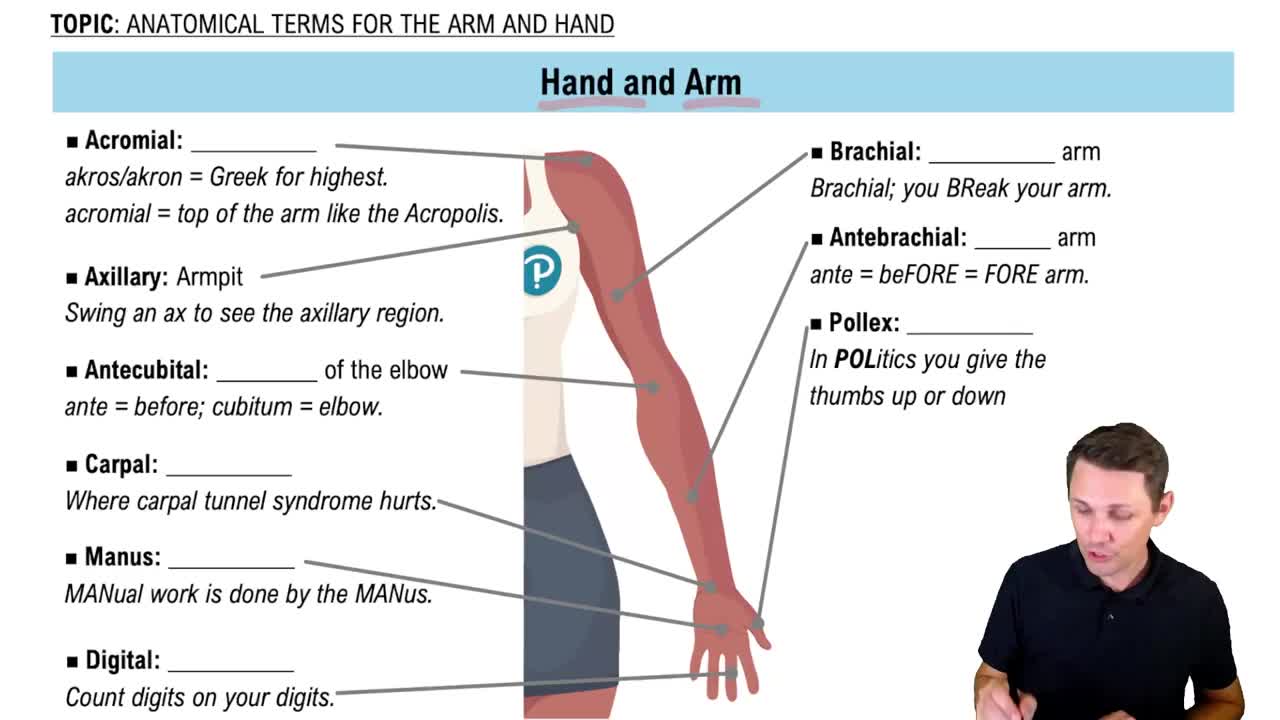
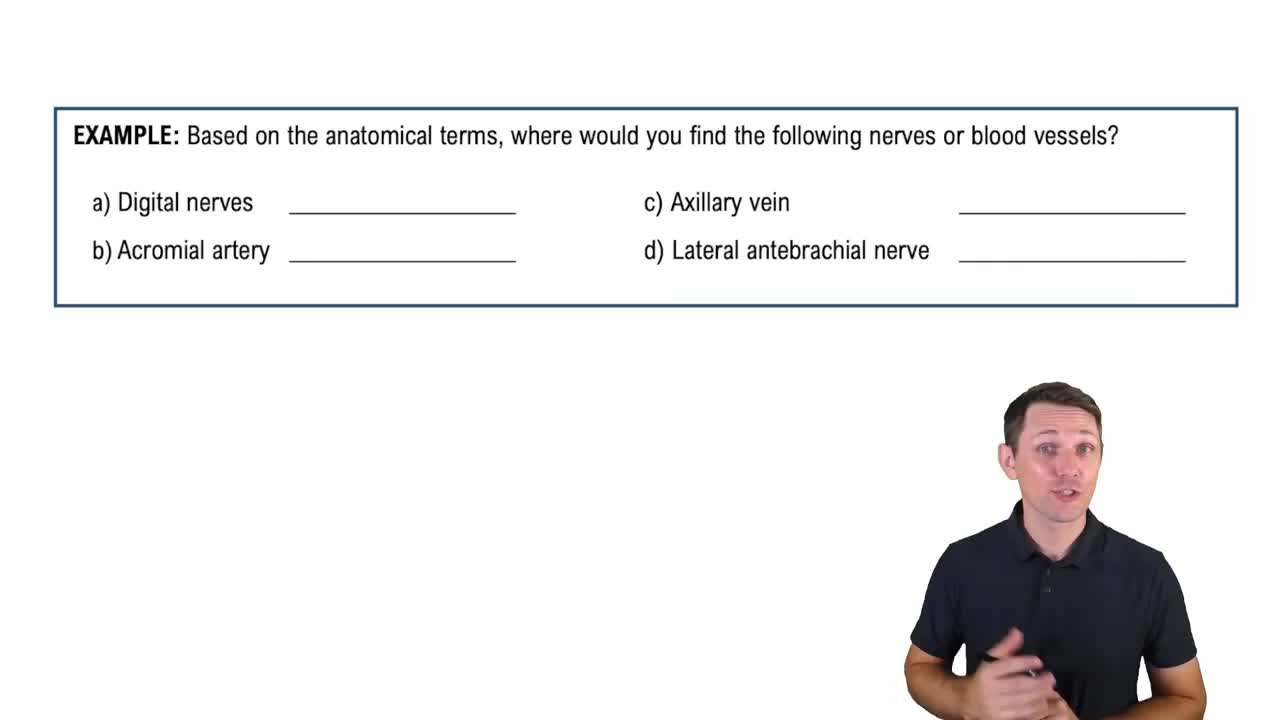
Anatomical Terms for the Arm and Hand Example 1
7133
views
166
rank
VideoThumbView.guidedCourse
03:17
The Arm and Hand
10064
views
209
rank
3
comments
Termini in questo insieme (61)
Nascondere definizioni
Clavicle: Sternal end
The medial end of the clavicle that articulates with the manubrium of the sternum.
Clavicle: Acromial end
The lateral end of the clavicle that articulates with the acromion of the scapula.
Clavicle: Conoid tubercle
A bony prominence on the inferior surface near the acromial end; attachment site for the conoid ligament.
Scapula: Spinous process
Also called the spine of the scapula; a prominent ridge on the posterior surface.
Scapula: Acromion
The lateral extension of the scapular spine that articulates with the clavicle.
Scapula: Supraspinous fossa
A depression above the spine on the posterior scapula; origin site for the supraspinatus muscle.
Scapula: Infraspinous fossa
A large depression below the spine on the posterior scapula; origin site for the infraspinatus muscle.
Scapula: Glenoid cavity
A shallow socket on the lateral scapula that articulates with the head of the humerus.
Scapula: Coracoid process
A hook-like projection on the anterior scapula; attachment site for muscles and ligaments.
Scapula: Lateral border
The edge of the scapula closest to the arm, running from the glenoid cavity to the inferior angle.
Scapula: Medial border
The edge of the scapula closest to the vertebral column.
Scapula: Subscapular fossa
A broad depression on the anterior surface of the scapula; origin site for the subscapularis muscle.
Humerus: Head
The rounded proximal end that fits into the glenoid cavity of the scapula.
Humerus: Greater tubercle
A large lateral projection near the head; attachment site for rotator cuff muscles.
Humerus: Lesser tubercle
A smaller anterior projection near the head; attachment site for rotator cuff muscles.
Humerus: Intertubercular sulcus
A groove between the greater and lesser tubercles; guides the tendon of the biceps brachii.
Humerus: Capitulum
A rounded knob on the distal lateral humerus that articulates with the radius.
Humerus: Trochlea
A spool-shaped structure on the distal humerus that articulates with the ulna.
Humerus: Lateral epicondyle
A bony projection on the distal lateral humerus; attachment site for forearm muscles.
Humerus: Medial epicondyle
A bony projection on the distal medial humerus; attachment site for forearm muscles.
Humerus: Coronoid fossa
A depression on the anterior distal humerus that receives the coronoid process of the ulna during flexion.
Humerus: Olecranon fossa
A large posterior depression on the distal humerus that receives the olecranon of the ulna during extension.
Radius: Head
The disc-shaped proximal end that articulates with the capitulum of the humerus and radial notch of the ulna.
Radius: Radial tuberosity
A roughened projection distal to the head; attachment site for the biceps brachii tendon.
Radius: Dorsal radial tuberosity
A posterior rough area on the radius near the styloid process; muscle attachment site.
Radius: Styloid process
A pointed projection at the distal end of the radius; attachment site for wrist ligaments.
Radius: Ulnar notch
A medial depression at the distal radius that articulates with the head of the ulna.
Ulna: Trochlear notch
A large C-shaped notch on the proximal ulna that articulates with the trochlea of the humerus.
Ulna: Olecranon process
The prominent posterior projection of the proximal ulna; forms the elbow's bony tip.
Ulna: Coronoid process
A triangular projection on the anterior proximal ulna; fits into the coronoid fossa of the humerus.
Ulna: Radial notch
A lateral depression on the ulna that articulates with the head of the radius.
Ulna: Head
The distal end of the ulna; articulates with the ulnar notch of the radius.
Ulna: Styloid process
A pointed projection at the distal end of the ulna; attachment site for wrist ligaments.
Wrist bones: Scaphoid
A proximal carpal bone on the thumb side; articulates with the radius.
Wrist bones: Lunate
A proximal carpal bone in the center of the wrist; articulates with the radius.
Wrist bones: Triquetrum
A proximal carpal bone on the medial side of the wrist.
Wrist bones: Pisiform
A small sesamoid bone on the anterior surface of the triquetrum.
Wrist bones: Trapezium
A distal carpal bone that articulates with the first metacarpal (thumb).
Wrist bones: Trapezoid
A distal carpal bone that articulates with the second metacarpal.
Wrist bones: Capitate
The largest distal carpal bone; articulates with the third metacarpal.
Wrist bones: Hamate
A distal carpal bone with a hook-like projection; articulates with the fourth and fifth metacarpals.
Hand bones: Metacarpals 1-V
Five long bones of the palm numbered from thumb (1) to little finger (5).
Hand bones: Proximal phalanges
The bones in the fingers closest to the palm.
Hand bones: Middle phalanges
The bones in the fingers between proximal and distal phalanges; absent in the thumb.
Hand bones: Distal phalanges
The bones at the tips of the fingers.
Long bone: Proximal epiphysis
The end of a long bone closest to the body's center.
Long bone: Distal epiphysis
The end of a long bone farthest from the body's center.
Long bone: Diaphysis
The shaft or central part of a long bone.
Long bone: Compact bone
Dense bone tissue forming the outer layer of bones.
Long bone: Spongy bone
Porous bone tissue inside epiphyses; contains red bone marrow.
Long bone: Medullary cavity
The hollow central cavity within the diaphysis containing yellow marrow.
Shoulder ligament: Acromioclavicular ligament
Connects the acromion of the scapula to the clavicle.
Shoulder ligament: Coracoclavicular ligament
Connects the coracoid process of the scapula to the clavicle.
Shoulder ligament: Coracoacromial ligament
Connects the coracoid process to the acromion of the scapula.
Shoulder ligament: Coracohumeral ligament
Connects the coracoid process of the scapula to the humerus.
Shoulder ligament: Glenohumeral ligaments
A group of ligaments reinforcing the shoulder joint capsule.
Shoulder tendon: Tendon of biceps brachii
Passes through the intertubercular sulcus of the humerus to attach to the scapula.
Elbow ligament: Ulnar collateral ligament
Connects the medial epicondyle of the humerus to the ulna.
Elbow ligament: Radial collateral ligament
Connects the lateral epicondyle of the humerus to the radius.
Elbow ligament: Annular ligament
Encircles the head of the radius, stabilizing the proximal radioulnar joint.
Elbow tendon: Tendon of biceps brachii
Attaches the biceps brachii muscle to the radial tuberosity.
 IndietroIndietro
 02:05