Skip to main content
Anatomy & Physiology
Il mio corso
Impara
Preparazione agli esami
AI Tutor
Guide di studio
Soluzioni per libri di testo
Flashcard
Esplora
Prova l'app
Il mio corso
Impara
Preparazione agli esami
AI Tutor
Guide di studio
Soluzioni per libri di testo
Flashcard
Esplora
Prova l'app
Indietro
Urinary System and Kidney Function - Anatomy & Physiology
Puoi toccare per girare la carta.
Organs of the urinary system
Puoi toccare per girare la carta.
👆
Organs of the urinary system
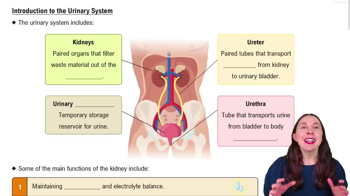
The urinary system includes the kidneys, ureters, urinary bladder, and urethra.
Avanzamenti del tracciato
I pulsanti di controllo sono stati cambiati in modalità "navigazione".
1/20
Video consigliati
VideoThumbView.guidedCourse
0:54
Introduction to the Urinary System Example 1
6572
views
178
rank
VideoThumbView.guidedCourse
2:57
The Urinary System
8697
views
257
rank
2
comments
Termini in questo insieme (20)
Nascondere definizioni
Organs of the urinary system
The urinary system includes the kidneys, ureters, urinary bladder, and urethra.
General functions of the urinary system
Filters blood to remove waste, regulates blood volume and pressure, controls electrolyte and acid-base balance, and produces urine.
Location of the kidneys
The kidneys are located retroperitoneally on either side of the vertebral column, between the T12 and L3 vertebrae.
Structure of the kidney
Each kidney has an outer cortex, inner medulla with renal pyramids, and a renal pelvis that collects urine.
Functions of the kidneys
Filter blood, regulate fluid and electrolyte balance, maintain acid-base homeostasis, produce hormones like erythropoietin, and activate vitamin D.
Pathway of blood flow through the kidney
Renal artery → segmental arteries → interlobar arteries → arcuate arteries → cortical radiate arteries → afferent arterioles → glomerulus → efferent arterioles → peritubular capillaries/vasa recta → cortical radiate veins → arcuate veins → interlobar veins → renal vein.
Definition of a nephron
The nephron is the functional unit of the kidney responsible for filtering blood and forming urine.
Major parts of a nephron
Renal corpuscle (glomerulus and Bowman's capsule), proximal convoluted tubule, loop of Henle, distal convoluted tubule, and collecting duct.
How glomerular filtrate is produced
Blood pressure forces plasma and small solutes through the glomerular capillaries into Bowman's capsule, forming filtrate.
Composition of glomerular filtrate
Similar to blood plasma but without large proteins and blood cells.
Factors affecting glomerular filtration rate (GFR)
Blood pressure, blood flow, filtration membrane permeability, and neural/hormonal regulation.
Role of tubular reabsorption
Reclaims water and solutes from the filtrate back into the blood to maintain homeostasis.
Osmotic concentration changes in filtrate through renal tubule
Filtrate becomes more concentrated in the descending loop of Henle and more dilute in the ascending loop.
Role of tubular secretion
Active transport of substances from blood into the tubular fluid to eliminate wastes and regulate pH.
Countercurrent mechanism in urine concentration
A system where filtrate flows in opposite directions in adjacent tubules, creating a gradient that concentrates urine.
Structures of the ureters
Muscular tubes that transport urine from the kidneys to the urinary bladder.
Structure of the urinary bladder
A hollow, muscular organ that stores urine until micturition.
Structure of the urethra
A tube that conducts urine from the bladder to the outside of the body.
Process of micturition
The bladder contracts and the urethral sphincters relax to expel urine.
Control of micturition
Involves voluntary and involuntary nervous system control of the detrusor muscle and urethral sphincters.
 IndietroIndietro

 0:54