Ch. 2 The Chemistry of Life
Amerman - Human Anatomy & Physiology 2nd Edition
Amerman2nd EditionHuman Anatomy & PhysiologyISBN: 9780136873822Non è quello che usi tu?Cambia libro di testo
Capitolo 2, Problema 2.111a

Which of the following is not a property of water?


a. Water has a high heat capacity.
b. Water doesn't take heat with it when it evaporates.
c. Water is a polar solvent in which many solutes will dissolve.
d. Water serves as a cushion and lubricant in the body.

Guida verificata passo dopo passo
1
Identify the properties of water that are commonly accepted in scientific literature.
Review each option and compare it with the known properties of water.
Understand that water has a high heat capacity, meaning it can absorb or release a significant amount of heat with little change in temperature.
Recognize that water is a polar solvent, which allows many substances to dissolve in it due to its ability to surround and interact with charged particles or polar molecules.
Consider the role of water in the body as a cushion and lubricant in various tissues and joints, facilitating smooth movement and providing protection against mechanical stress.

Concetti chiave

Ecco i concetti essenziali che devi comprendere per rispondere correttamente alla domanda.

Properties of Water

Water has unique properties that are essential for life, including high heat capacity, polarity, and its role as a solvent. These properties allow water to regulate temperature, dissolve various substances, and provide cushioning in biological systems.
Video consigliato:
Percorso guidato
04:07
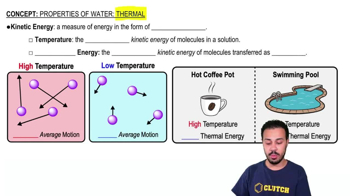
Properties of Water- Thermal

High Heat Capacity

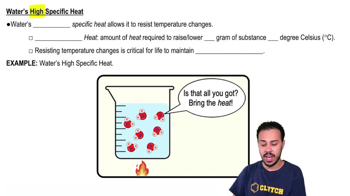
High heat capacity refers to water's ability to absorb and retain heat without a significant change in temperature. This property helps stabilize environmental temperatures and is crucial for maintaining homeostasis in living organisms.
Video consigliato:
Percorso guidato
03:25
Water’s High Specific Heat

Polarity of Water

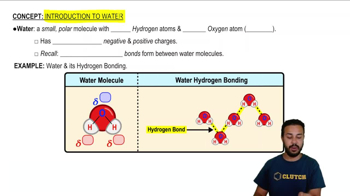
Water is a polar molecule, meaning it has a partial positive charge on one side and a partial negative charge on the other. This polarity allows water to dissolve many ionic and polar substances, making it an excellent solvent for biological reactions.
Video consigliato:
Percorso guidato
01:54
Introduction to Water
Pratica correlata
Domanda del libro di testo

Considering that water is a main component of the juices in the stomach and intestines, explain why digestion of lipids is more complicated than digestion of carbohydrates and proteins.

675
views

Domanda del libro di testo

In certain types of radioactive decay, the isotope releases a particle called an alpha particle, which contains two protons and two neutrons. When this happens, is the product still the same element? Why or why not?

975
views
Domanda del libro di testo

Many drugs and poisons exert their effects by blocking one or more enzymes. How could blocking an enzyme lead to the death of a cell?

1054
views
Domanda del libro di testo

The polysaccharide cellulose is not digestible by humans, as we lack the enzyme cellulase, which is required to break it down. Certain dietary supplements contain the enzyme cellulase and claim that being able to break down cellulose will help a person lose weight. But what do you think would happen if we could digest the cellulose we ate?

1008
views
Domanda del libro di testo

Which of the following statements correctly describes a solution?

a. In a solution the solute is chemically dissolved by the solvent.

b. Solutions involve large particles suspended in another component.

c. The particles in a solution will settle out if left to sit.

d. The amount of solute in a solution is expressed as the solution's concentration.

704
views
Domanda del libro di testo

Explain why monosaccharides are polar and fatty acids are nonpolar even though they both contain the same atoms.

1243
views