Skip to main content
General Biology
Il mio corso
Impara
Preparazione agli esami
AI Tutor
Guide di studio
Soluzioni per libri di testo
Flashcard
Esplora
Prova l'app
Il mio corso
Impara
Preparazione agli esami
AI Tutor
Guide di studio
Soluzioni per libri di testo
Flashcard
Esplora
Prova l'app
Indietro
Endosymbiotic Theory quiz #4
Puoi toccare per girare la carta.
According to the Endosymbiotic Theory, which type of bacterium is believed to have evolved into mitochondria?
Puoi toccare per girare la carta.
👆
According to the Endosymbiotic Theory, which type of bacterium is believed to have evolved into mitochondria?
An aerobic bacterium is believed to have evolved into mitochondria.
Avanzamenti del tracciato
I pulsanti di controllo sono stati cambiati in modalità "navigazione".
1/10
Flashcard correlate
Pratica correlata
Video consigliati
Endosymbiotic Theory definitions
Endosymbiotic Theory
13 Termini
Endosymbiotic Theory quiz #1
Endosymbiotic Theory
21 Termini
Endosymbiotic Theory exam
Endosymbiotic Theory
29 Termini
Endosymbiotic Theory
5. Cell Components
3 Problemi
Argomento
Brendan
Introduction to the Cytoskeleton
5. Cell Components
5 Problemi
Argomento
Jason
5. Cell Components
9 Argomenti
15 Problemi
Capitolo
Brendan
06:58
Endosymbiotic Theory
17213
views
167
rank
1
comments
Termini in questo insieme (10)
Nascondere definizioni
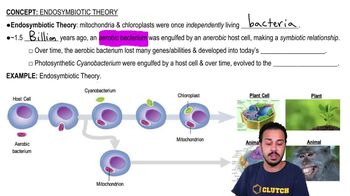
According to the Endosymbiotic Theory, which type of bacterium is believed to have evolved into mitochondria?
An aerobic bacterium is believed to have evolved into mitochondria.
Approximately how many years ago did the endosymbiotic events leading to mitochondria and chloroplasts occur?
These events occurred about 1.5 billion years ago.
What evidence supports the bacterial origin of mitochondria and chloroplasts?
Evidence includes similarities in DNA structure (small, circular DNA), ribosome type (70s ribosomes), and replication by binary fission.
What type of ribosomes are found in mitochondria and chloroplasts, and what does this indicate?
Mitochondria and chloroplasts contain 70s ribosomes, indicating a prokaryotic origin.
What happened to many of the genes of the engulfed bacteria over time?
Many genes were lost or transferred to the host cell's nucleus, leading to the evolution of the bacteria into organelles.
What is the significance of the endosymbiotic origin of mitochondria for the evolution of complex life?
The acquisition of mitochondria enabled cells to efficiently use oxygen, allowing for the evolution of complex multicellular organisms.
What is the main difference between the DNA found in mitochondria/chloroplasts and the DNA in the eukaryotic nucleus?
Mitochondria and chloroplasts have small, circular DNA, while the eukaryotic nucleus contains linear DNA.
According to the Endosymbiotic Theory, which type of bacterium is believed to have evolved into mitochondria?
An aerobic bacterium is believed to have evolved into mitochondria.
What evidence supports the bacterial origin of mitochondria and chloroplasts?
Evidence includes similarities in DNA structure (small, circular DNA), ribosome type (70s ribosomes), and replication by binary fission.
What happened to many of the genes of the engulfed bacteria over time?
Many genes were lost or transferred to the host cell's nucleus, leading to the evolution of the bacteria into organelles.
 IndietroIndietro

 06:58
06:58