Skip to main content
General Biology
Il mio corso
Impara
Preparazione agli esami
AI Tutor
Guide di studio
Soluzioni per libri di testo
Flashcard
Esplora
Prova l'app
Il mio corso
Impara
Preparazione agli esami
AI Tutor
Guide di studio
Soluzioni per libri di testo
Flashcard
Esplora
Prova l'app
Indietro
Enzymes quiz #3
Puoi toccare per girare la carta.
What is the function of enzymes in living things?
Puoi toccare per girare la carta.
👆
What is the function of enzymes in living things?
Enzymes function to catalyze and accelerate biochemical reactions necessary for life processes in living organisms.
Avanzamenti del tracciato
I pulsanti di controllo sono stati cambiati in modalità "navigazione".
1/40
Flashcard correlate
Pratica correlata
Video consigliati
Enzymes definitions
Enzymes
10 Termini
Enzymes quiz #1
Enzymes
30 Termini
Enzymes exam
Enzymes
29 Termini
Enzymes
7. Energy and Metabolism
6 Problemi
Argomento
Jason
Enzyme Activation Energy
7. Energy and Metabolism
5 Problemi
Argomento
Jason
7. Energy and Metabolism
10 Argomenti
13 Problemi
Capitolo
Brendan
02:32
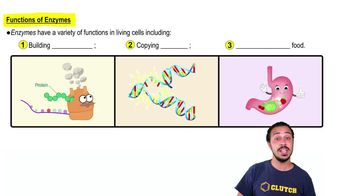
Functions of Enzymes
20531
views
329
rank
1
comments
02:25
Enzymes Example 1
16538
views
215
rank
02:55
Enzymes
22606
views
395
rank
Termini in questo insieme (40)
Nascondere definizioni
What is the function of enzymes in living things?
Enzymes function to catalyze and accelerate biochemical reactions necessary for life processes in living organisms.
What does the induced fit model of enzyme activity suggest about enzyme shape?
Enzymes change shape to fit the substrate.
How does a change in structure affect the function of an enzyme?
A change in structure can alter the active site, affecting substrate binding and the enzyme's catalytic efficiency.
What is a common characteristic of all enzymes?
They are proteins.
How do enzymes in the body speed up reactions?
Enzymes speed up reactions by lowering the activation energy required for the reaction to proceed.
What leads to the change in shape of the active site when temperature increases?
Increased temperature can cause denaturation, altering the enzyme's shape and active site.
To which part of an enzyme will a specific substrate bind?
A specific substrate will bind to the enzyme's active site.
How is the structure of an enzyme related to its function?
The enzyme's structure determines the shape of its active site, which is essential for substrate binding and catalysis.
What is true regarding the structure of enzymes?
They have a specific three-dimensional shape.
Why are enzymes essential to an organism’s metabolism?
Enzymes are essential because they catalyze metabolic reactions, allowing them to occur at rates necessary for life.
What determines the specific reaction that an enzyme will catalyze?
The specific shape and structure of the enzyme's active site determine the reaction it will catalyze.
What can change the shape of an enzyme's active site?
Temperature, pH, and inhibitors can change the shape of an enzyme's active site.
What determines the function of an enzyme?
The function of an enzyme is determined by its structure, particularly the shape of its active site.
Why is the “active site” of the enzyme important?
The active site is important because it is where the substrate binds and the reaction is catalyzed.
What factors can change the shape of an enzyme?
D) All of the above.
Which enzyme digests carbohydrates?
Amylase is an enzyme that digests carbohydrates.
What is the function of a protein kinase enzyme?
A) Adds a phosphate group.
What level of protein structure is involved in the formation of an enzyme's active site?
The tertiary structure of a protein is involved in the formation of an enzyme's active site.
What happens to the enzyme after the chemical reaction occurs?
The enzyme remains unchanged and can catalyze additional reactions.
Where on the enzyme does the substrate bind?
The substrate binds to the active site of the enzyme.
What is the function of an enzyme in biological systems?
Enzymes function to catalyze and speed up chemical reactions in biological systems.
Which conditions are likely to affect the shape of an enzyme? A) Temperature. B) pH. C) Substrate concentration. D) All of the above.
D) All of the above.
What is the primary function of enzymes in biological systems?
Enzymes act as biological catalysts that speed up chemical reactions without being consumed in the process.
What term is used to describe the reactants in an enzymatic reaction?
The reactants in an enzymatic reaction are called substrates.
Name three key cellular processes that rely on enzymes.
Protein synthesis, DNA replication, and food digestion all rely on enzymes.
What is denaturation in the context of enzymes?
Denaturation is the loss of an enzyme's shape, leading to a loss of its function.
What effect does substrate concentration have on enzyme activity?
Increasing substrate concentration increases enzyme activity up to a point, but too much can oversaturate the enzyme and reduce efficiency.
What is meant by the term 'biological catalyst'?
A biological catalyst is a molecule, like an enzyme, that speeds up a chemical reaction in living organisms without being consumed.
What is the optimal condition for enzyme activity?
Optimal conditions are the specific temperature and pH at which an enzyme functions most efficiently.
What role do enzymes play in protein synthesis?
Enzymes, such as ribosomes, catalyze the assembly of proteins from amino acids.
Describe the role of enzymes in digestion.
Enzymes break down food molecules into smaller components for absorption in the digestive system.
How does low temperature affect enzyme activity?
Low temperatures slow down enzyme activity by reducing molecular movement.
Why is it important for enzymes to have optimal environmental conditions?
Optimal conditions ensure maximum enzyme efficiency and prevent denaturation.
Can enzymes be used repeatedly in chemical reactions? Why or why not?
Yes, enzymes can be reused because they are not consumed or altered during the reaction.
What is the effect of oversaturating an enzyme with substrate?
Oversaturation can lead to a plateau in activity, as all enzyme active sites are occupied and cannot process more substrate simultaneously.
What is the significance of enzyme specificity?
Enzyme specificity ensures that each enzyme only catalyzes a particular reaction or type of reaction.
Why can't life rely on non-enzymatic reactions alone?
Non-enzymatic reactions are too slow to sustain the rapid biochemical processes required for life.
How do enzymes help in the breakdown of food in the stomach?
Enzymes catalyze the breakdown of complex food molecules into simpler forms for absorption.
What could happen if an enzyme is exposed to a pH far from its optimum?
The enzyme may denature and lose its ability to catalyze reactions efficiently.
What is the relationship between enzyme activity and product formation?
Higher enzyme activity results in more product being formed in a given time.
 IndietroIndietro

 02:32
02:32