Skip to main content
General Biology
Il mio corso
Impara
Preparazione agli esami
AI Tutor
Guide di studio
Soluzioni per libri di testo
Flashcard
Esplora
Prova l'app
Il mio corso
Impara
Preparazione agli esami
AI Tutor
Guide di studio
Soluzioni per libri di testo
Flashcard
Esplora
Prova l'app
Indietro
Fermentation & Anaerobic Respiration quiz #4
Puoi toccare per girare la carta.
How does lactic acid fermentation regenerate NAD+?
Puoi toccare per girare la carta.
👆
How does lactic acid fermentation regenerate NAD+?
Lactic acid fermentation reduces pyruvate to lactic acid using electrons from NADH, thereby regenerating NAD+ needed for glycolysis.
Avanzamenti del tracciato
I pulsanti di controllo sono stati cambiati in modalità "navigazione".
1/17
Flashcard correlate
Pratica correlata
Video consigliati
Fermentation & Anaerobic Respiration definitions
Fermentation & Anaerobic Respiration
15 Termini
Fermentation & Anaerobic Respiration quiz #1
Fermentation & Anaerobic Respiration
21 Termini
Fermentation & Anaerobic Respiration exam
Fermentation & Anaerobic Respiration
29 Termini
Fermentation & Anaerobic Respiration
8. Respiration
4 Problemi
Argomento
Jason
Review of Aerobic Cellular Respiration
8. Respiration
4 Problemi
Argomento
Jason
8. Respiration - Part 1 of 2
6 Argomenti
8 Problemi
Capitolo
Jason
8. Respiration - Part 2 of 2
5 Argomenti
8 Problemi
Capitolo
Brendan
03:34
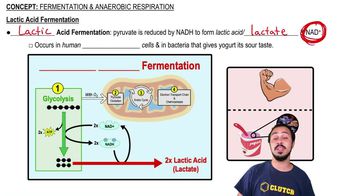
Lactic Acid Fermentation
15915
views
189
rank
07:51
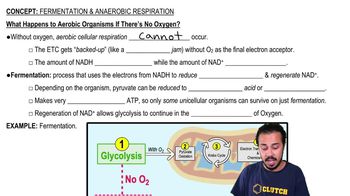
What Happens to Aerobic Organisms if There's No Oxygen?
19205
views
210
rank
02:02
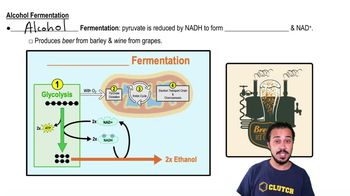
Alcohol Fermentation
15033
views
161
rank
Termini in questo insieme (17)
Nascondere definizioni
How does lactic acid fermentation regenerate NAD+?
Lactic acid fermentation reduces pyruvate to lactic acid using electrons from NADH, thereby regenerating NAD+ needed for glycolysis.
Why is fermentation important for glycolysis in the absence of oxygen?
Fermentation regenerates NAD+, which is essential for glycolysis to continue and produce ATP without oxygen.
What is the main product of alcohol fermentation?
The main product is ethanol (alcohol).
Which organisms commonly use alcohol fermentation?
Yeast and some types of bacteria.
Why can't multicellular organisms survive on fermentation alone?
Fermentation produces too little ATP to meet the energy needs of multicellular organisms.
What are some alternative final electron acceptors used in anaerobic respiration?
Nitrate (NO3-), sulfate (SO4^2-), and sometimes carbon dioxide.
What happens to the electron transport chain in the absence of oxygen?
It becomes backed up, causing NADH to accumulate and NAD+ levels to drop, halting aerobic respiration.
What is the role of NAD+ in glycolysis?
NAD+ acts as an electron carrier, accepting electrons during glycolysis and enabling the process to continue.
What causes the sour taste in yogurt?
Lactic acid produced by bacteria during lactic acid fermentation.
What is the main advantage of fermentation for cells?
It allows ATP production to continue in the absence of oxygen by regenerating NAD+.
What is the final electron acceptor in aerobic respiration?
Oxygen (O2) is the final electron acceptor.
What is the final electron acceptor in alcohol fermentation?
Acetaldehyde, derived from pyruvate, is reduced to ethanol and acts as the final electron acceptor.
What happens to muscle cells when lactic acid accumulates?
Muscle fatigue and soreness can occur, and activity must stop to allow oxygen levels to recover.
How does alcohol fermentation contribute to the production of alcoholic beverages?
Yeast perform alcohol fermentation, converting sugars into ethanol and carbon dioxide, which are essential for beer and wine production.
Why is fermentation considered less efficient than respiration?
Because it produces much less ATP per glucose molecule.
What is the role of glycolysis in fermentation?
Glycolysis breaks down glucose to pyruvate, producing ATP and NADH, and fermentation regenerates NAD+ so glycolysis can continue.
Why is oxygen called the final electron acceptor in aerobic respiration?
Because it accepts electrons at the end of the electron transport chain, allowing the chain to function and produce ATP.
 IndietroIndietro

 03:34
03:34