Skip to main content
General Biology
Il mio corso
Impara
Preparazione agli esami
AI Tutor
Guide di studio
Soluzioni per libri di testo
Flashcard
Esplora
Prova l'app
Il mio corso
Impara
Preparazione agli esami
AI Tutor
Guide di studio
Soluzioni per libri di testo
Flashcard
Esplora
Prova l'app
Indietro
Fungi exam
Puoi toccare per girare la carta.
Heterotrophic
Puoi toccare per girare la carta.
👆
Heterotrophic
Organisms that cannot produce their own food and rely on other sources of organic carbon.
Avanzamenti del tracciato
I pulsanti di controllo sono stati cambiati in modalità "navigazione".
1/28
Flashcard correlate
Pratica correlata
Video consigliati
Fungi definitions
Fungi
13 Termini
Fungi quiz #1
Fungi
20 Termini
Fungi quiz #2
Fungi
39 Termini
Fungi
29. Fungi
7 Problemi
Argomento
Jason
Fungi Reproduction
29. Fungi
5 Problemi
Argomento
Jason
29. Fungi
2 Argomenti
6 Problemi
Capitolo
Jason
08:59
Fungi - 1
6230
views
95
rank
09:57
Fungi - 2
4792
views
77
rank
1
comments
Termini in questo insieme (28)
Nascondere definizioni
Heterotrophic
Organisms that cannot produce their own food and rely on other sources of organic carbon.
What is the primary role of fungi in ecosystems?
Fungi act as decomposers, breaking down dead organic matter and recycling nutrients.
Mycorrhizae
Symbiotic association between fungi and plant roots that enhances nutrient and water absorption.
What is mycosis?
A fungal infection in animals.
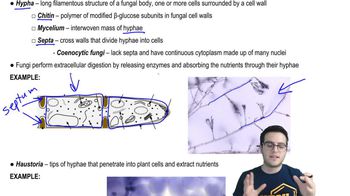
Hyphae
Long, filamentous structures that make up the body of a fungus.
What is the function of hyphae?
Hyphae absorb nutrients and form the structure of the fungus.
Mycelium
The mass of interwoven hyphae that forms the main body of a fungus.
What is extracellular digestion?
The process by which fungi secrete enzymes to break down organic material outside their bodies and then absorb the nutrients.
Saprophytes
Fungi that feed on dead plant matter.
What is the role of fungi in the carbon cycle?
Fungi break down cellulose and lignin, returning carbon to the environment.
Yeasts
Unicellular fungi essential in fermentation processes like bread and beer production.
What are haustoria?
Specialized hyphae used by parasitic fungi to extract nutrients from plant cells.
Lichen
A symbiotic association between a fungus and a photosynthetic organism, such as algae or cyanobacteria.
What is the difference between obligate and facultative symbiosis?
Obligate symbiosis is necessary for survival, while facultative symbiosis is beneficial but not essential.
Chitin
A tough, resilient polymer that makes up the cell walls of fungi and the exoskeletons of insects.
What are ectomycorrhizae?
Fungi that form symbiotic relationships with plant roots without penetrating the plant cells.
Arbuscular mycorrhizae
Fungi that penetrate the cells in the roots of plants, forming a symbiotic relationship.
What is the main benefit of mycorrhizae to plants?
They enhance nutrient and water absorption for the plants.
Septum
A partition that separates the cells within hyphae, allowing passage between them.
What is the significance of fungi in human food production?
Fungi, especially yeasts, are crucial in the production of bread, beer, and other fermented foods.
Mutualistic relationship
A type of symbiosis where both organisms benefit from the relationship.
What is the role of fungi in plant digestion?
Fungi help break down cellulose and lignin, aiding in the digestion of plant material.
Endophytes
Symbiotic fungi that live inside plants and provide benefits to their host.
What is the primary component of fungal cell walls?
Chitin, a modified Beta Glucose Polymer.
Extracellular digestion
The process by which fungi secrete enzymes to break down organic material outside their bodies and then absorb the nutrients.
What are the two main types of mycorrhizae?
Ectomycorrhizae and arbuscular mycorrhizae.
Symbiosis
A close and often long-term interaction between two different biological species.
What is the role of fungi in the carbon cycle?
Fungi break down cellulose and lignin, returning carbon to the environment.
 IndietroIndietro


 08:59