Skip to main content
General Biology
Il mio corso
Impara
Preparazione agli esami
AI Tutor
Guide di studio
Soluzioni per libri di testo
Flashcard
Esplora
Prova l'app
Il mio corso
Impara
Preparazione agli esami
AI Tutor
Guide di studio
Soluzioni per libri di testo
Flashcard
Esplora
Prova l'app
Indietro
Passive vs. Active Transport quiz #4
Puoi toccare per girare la carta.
How do antiporters contribute to ion balance in cells?
Puoi toccare per girare la carta.
👆
How do antiporters contribute to ion balance in cells?
Antiporters exchange ions across the membrane in opposite directions, helping maintain proper ion concentrations inside and outside the cell.
Avanzamenti del tracciato
I pulsanti di controllo sono stati cambiati in modalità "navigazione".
1/10
Flashcard correlate
Pratica correlata
Video consigliati
Passive vs. Active Transport quiz #1
Passive vs. Active Transport
28 Termini
Passive vs. Active Transport definitions
Passive vs. Active Transport
14 Termini
Passive vs. Active Transport exam
Passive vs. Active Transport
26 Termini
Passive vs. Active Transport
6. The Membrane
3 Problemi
Argomento
KeyshawnDavis
Osmosis
6. The Membrane
6 Problemi
Argomento
Jason
6. The Membrane
9 Argomenti
13 Problemi
Capitolo
Jason
03:28
Classes of Membrane Transport Proteins
19523
views
284
rank
3
comments
04:18
Passive vs. Active Transport
23390
views
353
rank
4
comments
Termini in questo insieme (10)
Nascondere definizioni
How do antiporters contribute to ion balance in cells?
Antiporters exchange ions across the membrane in opposite directions, helping maintain proper ion concentrations inside and outside the cell.
What is the main difference in the direction of molecule movement between passive and active transport?
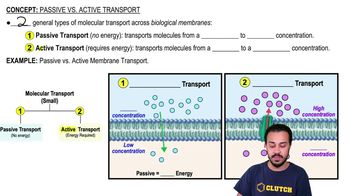
In passive transport, molecules move down their concentration gradient; in active transport, molecules move against their concentration gradient.
What is the main difference between passive and active transport in terms of energy requirement?
Passive transport does not require energy, while active transport requires an energy input, often from ATP.
In which direction do molecules move during passive transport relative to their concentration gradient?
Molecules move from an area of high concentration to an area of low concentration during passive transport.
Why does active transport require energy input?
Active transport requires energy because it moves molecules against their concentration gradient, from low to high concentration.
What is the function of a uniporter membrane transport protein?
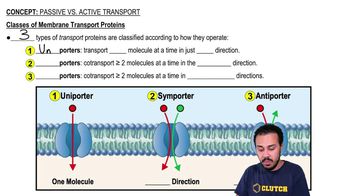
A uniporter transports one molecule at a time in one direction across the membrane.
How do symporters differ from uniporters in their transport mechanism?
Symporters transport two or more molecules at the same time in the same direction, while uniporters transport only one molecule in one direction.
How do antiporters contribute to ion balance in cells?
Antiporters exchange ions across the membrane in opposite directions, helping maintain proper ion concentrations inside and outside the cell.
What is the key distinguishing feature of antiporters compared to symporters?
Antiporters transport two molecules in opposite directions, while symporters transport them in the same direction.
What is the main difference in the direction of molecule movement between passive and active transport?
In passive transport, molecules move down their concentration gradient; in active transport, molecules move against their concentration gradient.
 IndietroIndietro

 03:28
03:28