Skip to main content
General Biology
Il mio corso
Impara
Preparazione agli esami
AI Tutor
Guide di studio
Soluzioni per libri di testo
Flashcard
Esplora
Prova l'app
Il mio corso
Impara
Preparazione agli esami
AI Tutor
Guide di studio
Soluzioni per libri di testo
Flashcard
Esplora
Prova l'app
Indietro
Viruses exam
1 Lo studente ha trovato utile questo
Puoi toccare per girare la carta.
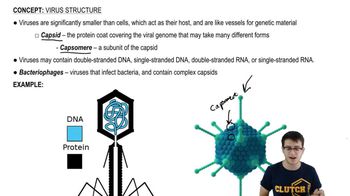
Capsid
Puoi toccare per girare la carta.
👆
Capsid
A protein coat that protects the genetic material of a virus.
Avanzamenti del tracciato
I pulsanti di controllo sono stati cambiati in modalità "navigazione".
1/30
Flashcard correlate
Pratica correlata
Video consigliati
Viruses definitions
Viruses
42 Termini
Viruses quiz #1
Viruses
30 Termini
Viruses quiz #2
Viruses
38 Termini
Viruses
17. Viruses
7 Problemi
Argomento
Jason
17. Viruses
1 Argomento
3 Problemi
Capitolo
Jason
04:50
Virus Structure
7587
views
108
rank
1
comments
08:04
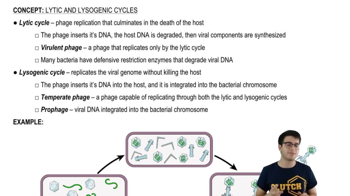
Lytic and Lysogenic Cycles
6495
views
54
rank
04:22
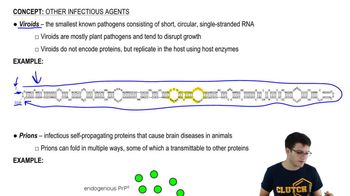
Viroids and Prions
4430
views
42
rank
Termini in questo insieme (30)
Nascondere definizioni
Capsid
A protein coat that protects the genetic material of a virus.
What is the function of a capsid?
To protect the genetic material of a virus.
Lytic Cycle
A viral replication cycle that results in the destruction of the host cell.
What happens during the lytic cycle?
The virus replicates and causes the host cell to burst, releasing new viruses.
Lysogenic Cycle
A viral replication cycle where the viral genome integrates into the host DNA without killing the host.
How does the lysogenic cycle differ from the lytic cycle?
In the lysogenic cycle, the viral genome integrates into the host DNA and replicates without killing the host.
Retrovirus
A type of virus that uses reverse transcription to integrate its RNA genome into the host DNA.
What enzyme do retroviruses use to integrate their RNA into host DNA?
Reverse transcriptase.
Viroids
The smallest known pathogens, consisting of a short circular single-stranded RNA, affecting plants.
What are viroids?
Small infectious agents that consist of a short circular single-stranded RNA and affect plants.
Prions
Infectious proteins that cause misfolding of normal proteins, leading to brain tissue damage.
How do prions cause disease?
By causing normal proteins to misfold, leading to toxic protein buildup in brain tissue.
Bacteriophage
A virus that infects bacteria, often with a complex capsid structure.
What is a bacteriophage?
A virus that specifically infects bacteria.
Viral Envelope
A membranous structure derived from the host cell membrane, found in some animal viruses.
What is the role of a viral envelope?
To help the virus enter host cells by fusing with the host cell membrane.
Prophage
Viral DNA that has been integrated into the bacterial chromosome.
What is a prophage?
The viral DNA when it is integrated into the bacterial genome.
Positive Sense RNA Virus
A single-stranded RNA virus with a genome that can be directly translated into proteins.
What is a positive sense RNA virus?
A virus with RNA that can be directly used as mRNA for protein synthesis.
Negative Sense RNA Virus
A single-stranded RNA virus with a genome that is complementary to the mRNA and must be transcribed before translation.
How does a negative sense RNA virus replicate?
Its RNA genome must be transcribed into mRNA by viral RNA polymerase before translation.
Reverse Transcriptase
An enzyme used by retroviruses to transcribe their RNA into DNA.
What is the function of reverse transcriptase?
To transcribe viral RNA into DNA in retroviruses.
Virulent Phage
A bacteriophage that replicates only by the lytic cycle.
What is a virulent phage?
A phage that replicates exclusively through the lytic cycle.
Temperate Phage
A bacteriophage capable of replicating through both the lytic and lysogenic cycles.
What is a temperate phage?
A phage that can replicate using both the lytic and lysogenic cycles.
Animal Virus
A virus that infects animal cells, often having a viral envelope and RNA genome.
How do animal viruses typically enter host cells?
By binding to cell surface receptors and entering through endocytosis or membrane fusion.
 IndietroIndietro

 04:50