 Indietro
An introduction to Metabolism(Lecture5,chapter8,page 1-25)(exam 2)
 02:17

Termini in questo insieme (20)
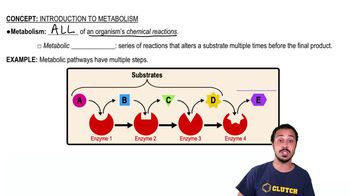
Metabolism is the totality of an organism’s chemical reactions.
A metabolic pathway is a series of steps where a specific molecule is altered to produce a product, each step catalyzed by a specific enzyme.
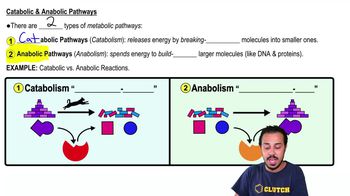
Catabolic pathways release energy by breaking down complex molecules; anabolic pathways consume energy to build complex molecules from simpler ones.
Cellular respiration is a catabolic pathway that breaks down glucose in the presence of oxygen.
Bioenergetics is the study of how energy flows through living organisms.
Kinetic energy is energy associated with motion, such as moving objects performing work.
Thermal energy is the kinetic energy associated with random movement of atoms or molecules; heat is thermal energy in transfer.
Chemical energy is potential energy available for release in a chemical reaction, stored in complex molecules like glucose.
Energy cannot be created or destroyed, only transferred or transformed; total energy of the universe is constant.
Every energy transfer increases the entropy (disorder) of the universe; some energy is lost as heat.
Entropy is a measure of molecular disorder or randomness.
A process that occurs without energy input and increases entropy; it has a negative free energy change (ΔG).
Gibbs free energy is the portion of a system’s energy that can do work at constant temperature and pressure.
A negative \(\Delta G\) means the process is spontaneous and can perform work.
Equilibrium is when forward and reverse reactions occur at the same rate, representing maximum stability.
Exergonic reactions release free energy and are spontaneous; endergonic reactions absorb free energy and are nonspontaneous.
ATP couples exergonic reactions to endergonic ones, providing energy for chemical, transport, and mechanical work.
ATP consists of ribose sugar, adenine base, and three phosphate groups.
Energy is released when the terminal phosphate bond is broken by hydrolysis, converting ATP to ADP and phosphate.
Energy comes from the chemical change to a lower free energy state in the products, not directly from the phosphate bonds.