Indietro

An introduction to Metabolism(Lecture5,chapter8,page 26-50)(exam 2)

I pulsanti di controllo sono stati cambiati in modalità "navigazione".
1/20
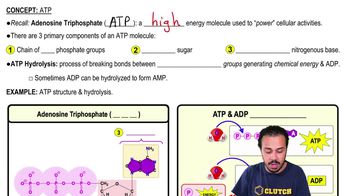
  • What is ATP and what happens during its hydrolysis?

    ATP (adenosine triphosphate) is a molecule with three phosphate groups. During hydrolysis, ATP loses one phosphate group, forming ADP and releasing energy.
  • How does ATP power transport work in cells?

    ATP provides energy to transport proteins, enabling them to move solutes across membranes by hydrolyzing to ADP and inorganic phosphate.
  • How does ATP power mechanical work in cells?

    ATP hydrolysis powers motor proteins that move vesicles and proteins along cytoskeletal tracks, converting chemical energy into mechanical work.
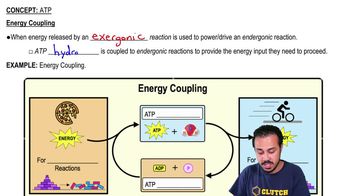
  • What is the ATP cycle?

    The ATP cycle involves ATP hydrolysis releasing energy for cellular work and ADP phosphorylation using energy from catabolism to regenerate ATP.
  • What reaction does the enzyme sucrase catalyze?

    Sucrase catalyzes the hydrolysis of sucrose into glucose and fructose by breaking the glycosidic bond using water.
  • What is activation energy (EA) in a chemical reaction?

    Activation energy is the initial energy required to break bonds in reactants to reach the unstable transition state before forming products.
  • What does the energy profile of an exergonic reaction show?

    It shows reactants absorbing activation energy to reach a transition state, then releasing energy as products form, resulting in a net energy release (ΔG < 0).
  • How do enzymes affect activation energy and reaction rate?

    Enzymes lower the activation energy barrier, allowing reactions to proceed faster at moderate temperatures without changing the overall ΔG.
  • What is the substrate of an enzyme?

    The substrate is the specific reactant molecule that an enzyme binds to and acts upon during a catalytic reaction.
  • What is the enzyme-substrate complex?

    It is the temporary complex formed when an enzyme binds its substrate at the active site before converting it to product.
  • What is the active site of an enzyme?

    The active site is a specific region on the enzyme, often a pocket or groove, where the substrate binds with a complementary shape.
  • What is the induced fit model of enzyme-substrate interaction?

    The enzyme changes shape slightly upon substrate binding, tightening around it to enhance catalysis by positioning chemical groups optimally.
  • How do enzymes hold substrates in the active site?

    Enzymes hold substrates by weak interactions such as hydrogen bonds, facilitating rapid conversion to products.
  • What happens to enzymes after catalyzing a reaction?

    Enzymes emerge unchanged and can catalyze multiple reactions, allowing small amounts to have large metabolic effects.
  • List mechanisms enzymes use to lower activation energy.

    • Orient substrates to facilitate reaction
    • Stretch substrates to weaken bonds
    • Provide a favorable microenvironment
    • Use active site amino acids to participate in reaction
  • Why is adding heat not a practical way to speed up reactions in cells?

    Heat can denature proteins and speeds all reactions non-selectively, whereas enzymes selectively catalyze needed reactions without damage.
  • Can enzymes change the overall free energy change (ΔG) of a reaction?

    No, enzymes do not change ΔG; they only lower the activation energy to speed up reactions that would occur eventually.
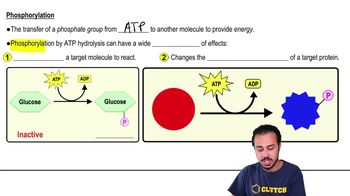
  • What is phosphorylation in the context of ATP energy transfer?

    Phosphorylation is the transfer of a phosphate group from ATP to another molecule, creating a phosphorylated intermediate that is more reactive.
  • How does ATP hydrolysis cause changes in proteins for cellular work?

    ATP hydrolysis induces changes in protein shape and binding ability, enabling transport and mechanical work.
  • What is the role of catabolism in the ATP cycle?

    Catabolism provides the free energy needed to add a phosphate group to ADP, regenerating ATP for cellular energy use.