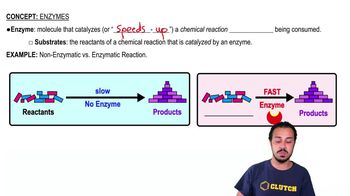
What happens when all enzyme molecules have their active sites engaged?
The enzyme is saturated, and the reaction rate can only be increased by adding more enzyme.
How does substrate concentration affect enzyme-catalyzed reaction rates?
Increasing substrate concentration speeds up the reaction rate until the enzyme becomes saturated.
What environmental factors affect enzyme activity?
Temperature, pH, and specific chemicals can influence enzyme activity.
What is the optimal temperature for enzyme activity?
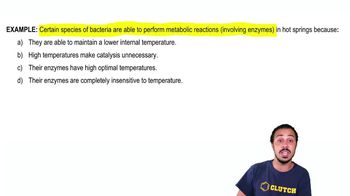
Each enzyme has an optimal temperature where it catalyzes reactions at the maximum rate before denaturing at higher temperatures.
How does the optimal temperature vary between human enzymes and thermophilic bacteria enzymes?
Human enzymes have an optimal temperature around 30–40°C, while thermophilic bacteria enzymes have an optimal temperature near 75°C.
What is the optimal pH for pepsin and trypsin enzymes?
Pepsin has an optimal pH of 2 (stomach enzyme), and trypsin has an optimal pH of 8 (intestinal enzyme).
What are cofactors in enzyme activity?
Cofactors are nonprotein helpers that bind permanently or reversibly to enzymes; they include inorganic metal ions and organic coenzymes.
What is the difference between competitive and noncompetitive enzyme inhibitors?
Competitive inhibitors bind to the active site blocking substrate binding; noncompetitive inhibitors bind elsewhere causing shape change and reduced activity.
How can competitive inhibition be overcome?
By increasing substrate concentration, which outcompetes the inhibitor for the active site.
What characterizes irreversible enzyme inhibitors?
They form covalent bonds with enzymes, permanently inactivating them, often seen in toxins and poisons.
How do mutations affect enzyme evolution?
Mutations alter amino acid sequences, potentially changing enzyme activity or substrate specificity, which natural selection can favor if beneficial.
What is allosteric regulation of enzymes?
Regulatory molecules bind at one site on a protein and affect enzyme function at a different site, either inhibiting or stimulating activity.
How do allosteric activators and inhibitors affect enzyme shape?
Activators stabilize the active form with functional active sites; inhibitors stabilize the inactive form.
What is cooperativity in enzyme activity?
Substrate binding to one active site triggers shape changes that stabilize the active form of other sites, amplifying enzyme response.
What is feedback inhibition in metabolic pathways?
The end product of a pathway binds to an enzyme early in the pathway to shut down further production, conserving resources.
How does compartmentalization affect enzyme function in cells?
It organizes metabolic pathways by localizing enzymes in specific organelles or complexes, enhancing efficiency.
Where are enzymes for the second and third stages of cellular respiration located in eukaryotic cells?
 Indietro
 02:32