 Indietro
Bio 1202 exam 2
 02:32

Termini in questo insieme (42)
Evolutionary history of a species or group of related species.
The discipline that classifies organisms and determines their evolutionary relationships.
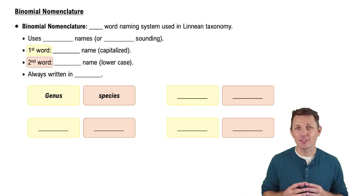
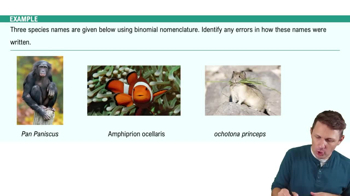
A two-part naming system introduced by Carolus Linnaeus consisting of Genus + specific epithet.
Domain, Kingdom, Phylum, Class, Order, Family, Genus, Species.
Homology: similarity due to shared ancestry (e.g., mammal forelimbs).
Analogy: similarity due to convergent evolution, not common ancestry (e.g., insect vs bird wings).
Consists of an ancestral species and all of its descendants.
Consists of an ancestral species and some, but not all, of its descendants.
Includes distantly related species but omits their most recent common ancestor.
An evolutionary novelty unique to a particular clade, used to infer phylogenies.
Orthologous: homologous genes from speciation, found in different species.
Paralogous: homologous genes from gene duplication within a species, can evolve new functions.
Method using constant mutation rates in certain genes to estimate evolutionary divergence times.
Cocci: spherical
Bacilli: rod-shaped
Spirilli: spiral-shaped
Gram-Positive: thick peptidoglycan wall, stains purple, susceptible to Penicillin.
Gram-Negative: thin peptidoglycan, outer membrane with LPS, stains pink, susceptible to Ciprofloxacin.
Sticky outer polysaccharide/protein layer that shields bacteria from host immune systems and aids adherence.
Metabolically inactive structures formed by bacteria to survive harsh conditions for centuries.
Fimbriae: allow attachment to substrates.
Pili (sex pili): longer, allow DNA exchange during conjugation.
One-way transfer of DNA between prokaryotes via a pilus and mating bridge, requiring the F factor.
Subgroup from which mitochondria evolved through endosymbiosis (e.g., Rhizobium, Agrobacterium).
Gram-negative photoautotrophs that generate O2; chloroplasts evolved from them via endosymbiosis.
Exotoxins: actively secreted proteins.
Endotoxins: lipopolysaccharides released only when bacteria die.
Monophyletic supergroup named for Stramenopiles, Alveolates, and Rhizarians.
Photosynthetic protists with one hairy and one smooth flagellum (e.g., Diatoms, Brown Algae).
Alveolates with two flagella and cellulose plates; cause toxic red tides.
Protists using cilia to move; undergo conjugation exchanging haploid micronuclei (e.g., Paramecium).
Rhizarians with porous calcium carbonate shells (tests) and threadlike pseudopodia.
Includes Red Algae, Green Algae, and Land Plants.
Accessory pigment in Red Algae that masks chlorophyll and allows absorption of blue/green light in deep water.
Includes Amoebozoans (lobe/tube-shaped pseudopodia) and Opisthokonts (animals, fungi).
Life cycle alternating between haploid gametophytes (produce gametes by mitosis) and diploid sporophytes (produce spores by meiosis).
Land plants named for retaining the diploid embryo within female gametophyte tissues.
Sporangia: produce haploid spores.
Sporopollenin: coats spore walls to prevent desiccation.
Archegonia: female gametangia producing eggs.
Antheridia: male gametangia producing sperm.
Localized regions of cell division at root and shoot tips allowing continuous upward and downward growth.
Nonvascular land plants (Liverworts, Mosses, Hornworts) dominated by the gametophyte generation.
Ferns, Lycophytes, Horsetails; dominated by the sporophyte generation and require water for flagellated sperm.
Consists of megasporangium, megaspore, and protective integuments (1 in gymnosperms, 2 in angiosperms).
Developed male gametophyte protected by a pollen wall; eliminates the requirement of water for fertilization.
"Naked seed" plants bearing seeds on cones (Conifers, Cycads, Ginkgo, Gnetophytes).
Stigma: sticky tip
Style: neck
Ovary: contains ovules
Anther: produces pollen
Filament: supporting stalk
Angiosperm process where one sperm fertilizes the egg (\(2n\) zygote) and another fuses with two polar nuclei (\(3n\) endosperm).
Monocots: 1 cotyledon, parallel leaf veins, scattered vascular tissue.
Eudicots: 2 cotyledons, netlike veins, ringed vascular tissue.