 Indietro
bio 140 - chapter 2 to 3
 05:43
05:43
Termini in questo insieme (30)
A weak interaction between a hydrogen atom covalently bonded to one electronegative atom and another electronegative atom, crucial for water’s unique properties.
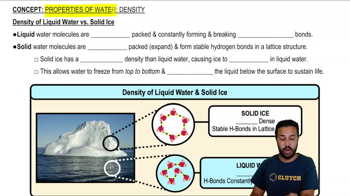
The amount of mass per unit volume of a substance, often expressed as grams per cubic centimeter (g/cm³) for liquids and solids.
The potential energy of water in a system, influenced by solute concentration and pressure, affecting water movement.
The amount of heat energy required to raise or lower the temperature of one gram of a substance by one degree Celsius.
The amount of heat energy needed to convert one gram of a liquid into a gas without changing its temperature.
A chemical that increases the concentration of hydrogen ions (H⁺) in a solution, resulting in a pH less than 7.
A chemical that decreases the concentration of hydrogen ions (H⁺) or increases hydroxide ions (OH⁻), resulting in a pH greater than 7.
A positively charged ion that plays a central role in acid-base chemistry and biological systems.
A negatively charged ion produced when bases dissociate in water, inversely related to hydrogen ion concentration.
A substance that resists changes in pH by donating or accepting hydrogen ions to maintain homeostasis.
A scale from 0 to 14 measuring acidity or basicity of a solution based on hydrogen ion concentration.
A scale where each unit change represents a tenfold change in hydrogen ion concentration.
A biological buffer involving HCO₃⁻ and H₂CO₃ that helps maintain blood pH around 7.
Molecules containing covalently linked carbon and hydrogen atoms, essential to life.
Organic molecules composed exclusively of carbon and hydrogen atoms.
Specific groups of atoms within molecules that have characteristic properties, such as hydroxyl (–OH), carboxyl (–COOH), amino (–NH₂), and phosphate (–PO₄).
Monomers are single molecular units; polymers are large molecules made of many monomers linked covalently.
A chemical reaction that links monomers by removing a water molecule, forming a covalent bond.
A chemical reaction that breaks covalent bonds between monomers by adding a water molecule.
Biomolecules made of carbon, hydrogen, and oxygen; serve as energy sources and structural components.
The monomers of proteins, each containing an amino group, carboxyl group, and a unique R group.
The monomers of nucleic acids, composed of a sugar, phosphate group, and nitrogenous base.
Hydrophobic biomolecules including fats, phospholipids, steroids, and waxes, important for energy storage and membranes.
A covalent bond linking the carboxyl group of one amino acid to the amino group of another in a protein chain.
The specific sequence and number of amino acids in a polypeptide chain.
Local folding patterns of a polypeptide backbone into alpha helices or beta sheets stabilized by hydrogen bonds.
The overall three-dimensional shape of a single polypeptide chain, including interactions between R groups.
The association of multiple polypeptide chains into a single functional protein complex.
A protein that has lost its native structure and function due to environmental changes like pH or temperature.
Specialized proteins that assist other proteins in folding correctly or refolding after denaturation.