 Indietro
Bio oct 30th chapter 8
 04:45

Termini in questo insieme (26)
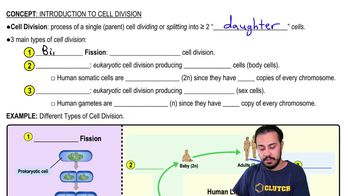
Cell division is the splitting of one parent cell into two genetically identical daughter cells, enabling cellular reproduction.
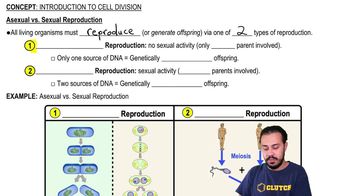
What is Asexual reproduction?
Asexual reproduction is cell division resulting in reproduction of a whole organism that produces clones (genetically identical individuals), common in single-celled and SOME multicellular organisms.
Sexual reproduction requires fusion of gametes (egg and sperm), involves a special cell division that ONLY OCCURS in reproductive organs, and produces genetically unique offspring. (not identical to parents/other offspring).
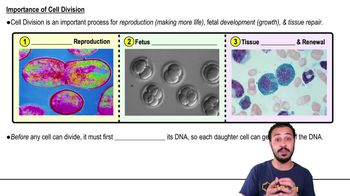
Cell division allows a zygote to develop into an embryo and then a mature organism, and supports renewal and repair of tissues.
Prokaryotes divide by binary fission, splitting in half their single circular DNA molecule (prokaryotic chromosome). *SHORTER THEN EUKARYOTIC CHROMOSOME.
Mitosis supports growth/maintenance and asexual reproduction (multicellular organisms)
Meiosis produces gametes (egg/sperm) in testes and ovaries for sexual reproduction.
What is a Eukaryotic chromosome?
A chromosome is a single DNA strand with hundreds or thousands of genes, associated with proteins that maintain structure and regulate gene expression.
Chromatin is the structure of DNA and it's proteins in a diffuse form of long thin fibers during most of the cell cycle; it coils into distinct chromosomes when the cell prepares to divide.
*EACH CHROMOSOMES CAN BE SEEN W/ A LIGHT MICROSCOPE.
Sister chromatids are two identical copies of a chromosome attached by proteins at the centromere, separating during cell division.
The cell cycle is the ordered sequence from cell formation to division into 2 daughter cells, includes: interphase (growth, high metabolic activity, 90% of cell cycle) and mitotic phase (cell division).
Interphase includes G1 1ST GAP (normal functions happen), S SYTHESIS PHASE (DNA replication), and G2 2ND GAP (normal functions and preparation for division).
The mitotic phase includes mitosis (nucleus division) and cytokinesis (cytoplasm division/separation of 2 daughter cells), producing two identical daughter cells.
Chromatin coils into chromosomes; mitotic spindle forms from centrosomes; spindle fibers begin to organize.
Nuclear envelope breaks down; spindle fibers attach to kinetochores on sister chromatids; chromosomes begin moving toward cell center.
Chromosomes align at the metaphase plate with kinetochores attached to spindle fibers from opposite poles.
Sister chromatids separate as centromeres split; motor proteins pull chromatids to opposite poles(ATP powered); spindle fibers shorten and cell elongates.
Daughter nuclei form at poles; nuclear envelopes reassemble; chromosomes uncoil; mitosis is finished.
A cleavage furrow (groove in cell surface) forms as actin and myosin filaments contract, furrow pinches the parent cell into two daughter cells.
Vesicles form a cell plate at the center, which grows and fuses with the plasma membrane, creating two daughter cells with new cell walls.
Anchorage dependence means cells must be in contact w/ a solid surface to divide, common in most animal cells.
Density-dependent inhibition is when crowded cells stop dividing, preventing overgrowth.
what is chemical and growth factors?
Chemical factors: Cells need certain nutrients to grow.
Growth factors: Certain proteins needed to proceed with division.
Cancer is the disease of the CELL CYCLE and results from cells not recognizing signals that regulate cell cycle.
Benign tumors abnormal cells stay in original location.
malignant tumors abnormally produces cells that spread into other tissues in other parts of body.
Metastasis is the spread of cancer cells beyond original place by entering bloodstream from blood vessels that grow TOWARDS the tumor.
How many eukaryotic chromosomes does humans, dogs, and hedgehogs have?
Humans = 46
Dogs = 78
Hedgehogs = 90