 Indietro
Bio October 21st (unit 5)
 02:21

Termini in questo insieme (29)
what is the Plasma membrane? Where are proteins, hydrophobic, and hydrophilic regions?
Flexible boundary between living cell and its environment that regulates material flow in and out of the cell.
Proteins - lipid bilayer
Hydrophobic - in membrane
Hydrophilic - in aqueous solutions in/out membrane.
Fluid mosaic model?
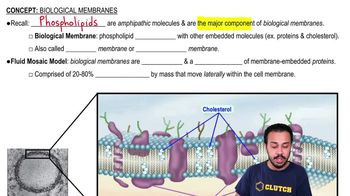
Describes membrane structure as diverse protein molecules suspend in a fluid phospholipid bilayer.
Selective permeability?
some substances can cross plasma membrane more easily than others.
Phospholipid bilayer?
Diffusion?
Substances that diffuse easily through membrane?
Small nonpolar molecules like O2 and CO2 exits cell BUT NOT ions and polar molecules.
Osmosis?
Tonicity?
Isotonic solution?
Solution with equal solute concentration inside and outside the cell; water moves equally both ways. ANINIMAL AND PLANT CELLS.
Hypotonic solution?
HYPOTONIC: Solution with lower solute concentration than inside the cell; water enters the cell causing swelling.
Effect of hypotonic solution on animal vs plant cells?
Animal cells may sweat to much and lyse (burst); plant/fungal cells become turgid which is a rigid cell wall protecting it against LYSIS and turgor pressure prevents excessive water up take.
Hypertonic solution and what does it do to animal and plant cells?
Solution with higher solute concentration outside the cell; water moves out of cell.
Animal: will shrivel and die.
Plants: shrivel but rigid wall can't change shape.
Plasmolysis?
Condition in plant cells where the plasma membrane pulls away from the cell wall due to water loss and then wilts a cells begin to die.
Osmoregulation? Example?
Control of water balance and solute concentration in the body to prevent excess water uptake or loss. EX: freshwater fish.
Facilitated diffusion?
Passive transport of molecules across membrane with help of transport proteins such as sugars, amino acids, ions, and water.
Channel protein?
simple channel for molecule to pass through membrane.
Carrier protein?
Transport protein binds to solute causing it to change shape to move it across the membrane.
Aquaporin?
Channel protein specifically allowing passage of water.
Active transport?
Energy-requiring process moving solutes against their concentration gradient (low-high) using ATP.
Sodium-potassium pump?
Steps of active transport?
1. Solute binds protein, 2. ATP changes protein shape, 3. Solute released to opposite end, 4. Protein goes back to original shape.
Exocytosis?
Process where cells export large molecules(proteins, polysaccharides, insult) by vesicles budding off Golgi apparatus and fusing with the plasma membrane. content of vesicle release. EX: insulin by pancreas.
Endocytosis?
Phagocytosis?
Pseudopodia?
Receptor-mediated endocytosis?
Example of receptor-mediated endocytosis?
Cholesterol is taken up by human cells using receptor proteins and coated pits.
Use of tonicity in food preservation?