 Indietro
Biological Macromolecules and Carbohydrates
 01:17
01:17
Termini in questo insieme (20)
Biological macromolecules are large, complex organic molecules essential for life, with unique properties arising from their atomic arrangement and functional groups.
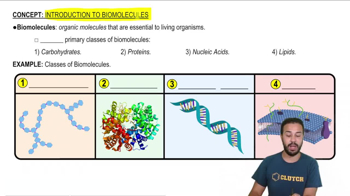
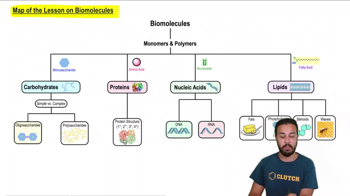
The four major classes are carbohydrates, proteins, nucleic acids, and lipids.
Carbohydrates, proteins, and nucleic acids are polymers; lipids are not polymers.
A polymer is a large molecule made of repeating subunits called monomers linked by covalent bonds.
A dehydration reaction synthesizes polymers by removing a water molecule to form a new covalent bond between monomers.
Hydrolysis breaks polymers into monomers by adding a water molecule, breaking the covalent bond.
Monosaccharides are the simplest carbohydrates, single sugar molecules like glucose, often with formula multiples of (CH2O).
Polysaccharides are polymers of many sugar monomers linked together, such as starch and cellulose.
Carbohydrates store energy and provide structural support to cells and organisms.
They exist in dynamic equilibrium between linear and ring forms, with ring forms favored in cells.
A glycosidic linkage is a covalent bond formed between two monosaccharides during dehydration to make disaccharides or polysaccharides.
Starch is a plant storage polysaccharide made of glucose monomers, stored as granules for energy reserves.
Glycogen is a highly branched glucose polymer used by animals for rapid energy release, stored mainly in liver and muscle cells.
They differ in the orientation of the hydroxyl group on carbon 1: α has it below the ring, β has it above.
Amylose has α-1,4 glycosidic linkages forming a helical structure; cellulose has β-1,4 linkages forming straight, rigid fibers.
Cellulose forms strong fibers via hydrogen bonds between β-glucose chains, making plant cell walls tough and rigid.
Chitin is a polysaccharide similar to cellulose but with nitrogen-containing groups, providing structure in fungal cell walls and arthropod exoskeletons.
Glucose has many polar hydroxyl (-OH) groups that form hydrogen bonds with water, making it soluble.
Enzymes speed up dehydration and hydrolysis reactions, facilitating polymer synthesis and breakdown in cells.
Poly- means many; mono- means one, referring to many monomers forming a polymer.