 Indietro
Biomolecules - General Biology Chapter 4
 01:17
01:17
Termini in questo insieme (20)
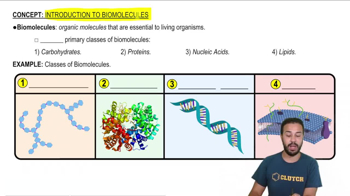
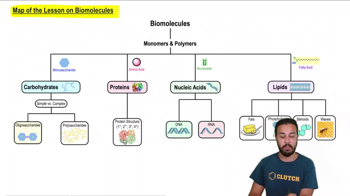
Biomolecules are organic molecules that are essential for life, including carbohydrates, lipids, proteins, and nucleic acids.
Carbohydrates provide energy and structural support in cells.
Monosaccharides are simple sugars like glucose that serve as the basic units of carbohydrates.
Disaccharides are carbohydrates made of two monosaccharides linked together, such as sucrose.
Polysaccharides are long chains of monosaccharides used for energy storage or structural support, like starch and cellulose.
Lipids store energy, form cell membranes, and act as signaling molecules.
The main types of lipids are fats, phospholipids, and steroids.
A triglyceride consists of one glycerol molecule bonded to three fatty acid chains.
Saturated fatty acids have no double bonds; unsaturated fatty acids have one or more double bonds.
Phospholipids have hydrophilic heads and hydrophobic tails and form the bilayer of cell membranes.
Proteins are polymers of amino acids linked by peptide bonds.
A protein's shape and amino acid sequence determine its function.
The four levels are primary, secondary, tertiary, and quaternary structure.
The primary structure is the linear sequence of amino acids in a protein.
Nucleic acids are biomolecules that store and transmit genetic information, including DNA and RNA.
Nucleotides are the monomers of nucleic acids, composed of a sugar, phosphate group, and nitrogenous base.
DNA contains the bases adenine, thymine, cytosine, and guanine.
Adenine pairs with thymine, and cytosine pairs with guanine via hydrogen bonds.
RNA helps in protein synthesis and carries genetic information from DNA to ribosomes.
RNA has the sugar ribose, uses uracil instead of thymine, and is usually single-stranded.