Skip to main content
General Biology
Il mio corso
Impara
Preparazione agli esami
AI Tutor
Guide di studio
Soluzioni per libri di testo
Flashcard
Esplora
Prova l'app
Il mio corso
Impara
Preparazione agli esami
AI Tutor
Guide di studio
Soluzioni per libri di testo
Flashcard
Esplora
Prova l'app
Indietro
Carbon and the Molecular Diversity of Life - General Biology
Puoi toccare per girare la carta.
What are the four emergent properties of water important for life?
Puoi toccare per girare la carta.
👆
What are the four emergent properties of water important for life?
Cohesion, moderation of temperature, expansion upon freezing, and solvent properties
.
Avanzamenti del tracciato
I pulsanti di controllo sono stati cambiati in modalità "navigazione".
1/20
Video consigliati
03:35
Carbon is an Excellent Building Block
22707
views
903
rank
04:19
Carbon
29897
views
708
rank
2
comments
Termini in questo insieme (20)
Nascondere definizioni
What are the four emergent properties of water important for life?
Cohesion, moderation of temperature, expansion upon freezing, and solvent properties
.
Why is carbon the basis for all biological molecules?
Carbon can form
four covalent bonds
with a variety of atoms, allowing it to form diverse and complex molecules.
What is organic chemistry?
The study of compounds that contain
carbon
, regardless of their origin.
What did Stanley Miller's experiment demonstrate?
The abiotic synthesis of organic compounds, supporting the idea that life could have originated from non-living molecules.
What elements make up the major elements of life?
Carbon (C), Hydrogen (H), Oxygen (O), Nitrogen (N), Sulfur (S), and Phosphorus (P)
.
How does electron configuration affect carbon's bonding?
Carbon has
four valence electrons
, enabling it to form four covalent bonds with other atoms.
What shape do carbon atoms bonded to four other atoms form?
A
tetrahedral shape
.
What are hydrocarbons?
Organic molecules consisting only of
carbon and hydrogen
, often found in fats and can release large amounts of energy.
What are isomers?
Compounds with the same molecular formula but different
structures and properties
.
What are enantiomers and why are they important?
Isomers that are mirror images; important in pharmaceuticals because
different enantiomers can have different biological effects
.
What are functional groups?
Components of organic molecules most commonly involved in
chemical reactions
, giving molecules unique properties.
Name three functional groups important in life processes.
Hydroxyl (-OH), Carboxyl (-COOH), and Amino (-NH2)
.
What is ATP and why is it important?
Adenosine triphosphate (ATP) is an organic phosphate that stores potential energy used by cells when it reacts with water.
What happens when ATP reacts with water?
ATP converts to ADP and inorganic phosphate, releasing
energy
for cellular processes.
How do carbon skeletons vary?
They vary in
length, branching, double bond position, and presence of rings
.
What is the significance of carbon's ability to form four bonds?
It allows for the formation of
large, complex, and diverse organic molecules
essential for life.
What is the role of carbon chains in organic molecules?
They form the
skeletons
of most organic molecules, providing structure and diversity.
What is the difference between structural isomers and enantiomers?
Structural isomers differ in the
covalent arrangement
of atoms; enantiomers are mirror images differing in spatial arrangement.
Why are organisms sensitive to subtle variations in molecules?
Because even small changes like different enantiomers can lead to
different biological effects
.
What is the chemical basis for the diversity of organic molecules?
The versatility of
carbon's bonding
and the variety of functional groups attached to carbon skeletons.
 IndietroIndietro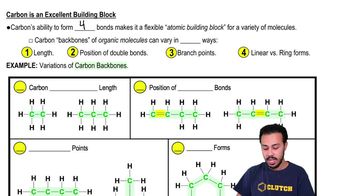
 03:35
03:35