 Indietro
Cell Communication in General Biology
 05:03

Termini in questo insieme (31)
It coordinates activities by allowing cells to detect and respond to signals, facilitating growth, immune responses, and development.
It evolved in prokaryotes and single-celled eukaryotes and was later adapted by multicellular organisms.
A process where bacteria sense population density via signaling molecules, influencing behaviors like biofilm formation and toxin secretion.
Because it interferes with bacterial communication that controls harmful behaviors, reducing infection severity.
They secrete factors to locate opposite mating types, triggering a conserved signal transduction pathway leading to mating.
Local signaling (direct contact, paracrine, synaptic) and long-distance signaling (hormones traveling through the circulatory system).
Signaling where secreted molecules affect nearby target cells.
It occurs in the nervous system where neurotransmitters cross synapses to target specific cells.
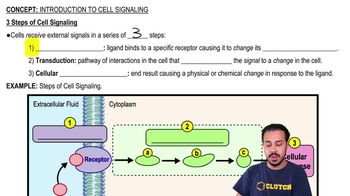
Reception, transduction, and response.
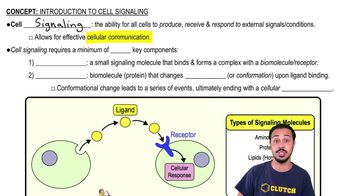
A signaling molecule (ligand) binds specifically to a receptor protein, often causing a shape change.
In the plasma membrane, though some are intracellular.
G protein-coupled receptors (GPCRs), receptor tyrosine kinases (RTKs), and ion channel receptors.
They activate G proteins, which then activate enzymes or ion channels.
They phosphorylate tyrosine residues, triggering multiple signaling pathways.
They open or close in response to ligands, allowing ions to flow across the membrane.
They are located in the cytoplasm or nucleus and bind small or hydrophobic ligands like steroid hormones.
It often acts as a transcription factor regulating gene expression.
A series of protein kinases activating each other by adding phosphate groups, amplifying the signal.
They remove phosphate groups, turning off the signal.
Small nonprotein molecules or ions that relay signals inside the cell, e.g., cyclic AMP (cAMP) and Ca2+.
Produced from ATP by adenylyl cyclase; it activates protein kinase A.
They relay signals with tightly regulated concentrations, often released from cellular compartments.
They are produced by cleavage of membrane phospholipids and help release Ca2+ from the endoplasmic reticulum.
Regulation of gene expression, changes in enzyme activity, ion channel opening, or metabolic changes.
Through enzyme cascades that greatly increase the magnitude of the response.
Different cell types have different proteins, allowing specific responses to the same signal.
They organize and increase the efficiency of signal transduction pathways.
It inactivates signals to prevent prolonged or inappropriate responses.
Programmed cell death that prevents damage to neighboring cells and is essential for development and tissue health.
Internal or external signals trigger it, involving a cascade of proteases called caspases.
Dysregulation is implicated in cancer, Parkinson's, and Alzheimer's diseases.