Indietro

Cell Cycle, Mitosis, Meiosis, and Genetic Variation

I pulsanti di controllo sono stati cambiati in modalità "navigazione".
1/22
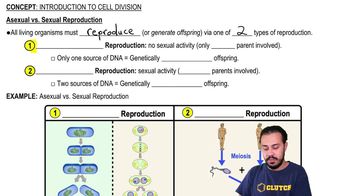
  • What is the primary function of cell division in unicellular and multicellular organisms?

    Unicellular organisms: cell division reproduces the entire organism.
    Multicellular organisms: cell division supports development, growth, and repair.
  • What is the difference between mitosis and meiosis in terms of chromosome number in daughter cells?

    Mitosis: produces genetically identical daughter cells with the same chromosome number.
    Meiosis: produces nonidentical daughter cells with half the chromosome number.
  • What is chromatin and how is it related to chromosomes?

    Chromatin is DNA and protein complex that condenses to form chromosomes during cell division.
  • What holds sister chromatids together and what happens to them during cell division?

    Sister chromatids are held together by a centromere and separate during cell division.
  • Name the phases of interphase and their main activities.

    G1 phase: cell growth and organelle development.
    S phase: DNA synthesis and chromosome duplication.
    G2 phase: further growth and preparation for mitosis.
  • List the five phases of mitosis and a key event in each.

    Prophase: chromatin condenses.
    Prometaphase: nuclear envelope breaks down.
    Metaphase: chromosomes align at metaphase plate.
    Anaphase: sister chromatids separate.
    Telophase: nuclei reform.
  • What is the mitotic spindle and its components?

    The mitotic spindle is made of microtubules including centrosomes, kinetochore microtubules, nonkinetochore microtubules, and asters that organize chromosome movement.
  • How does cytokinesis differ between animal and plant cells?

    In animal cells, cytokinesis occurs by cleavage furrow formation; in plant cells, a cell plate forms.
  • Describe binary fission in prokaryotes.

    Binary fission is a type of cell division where the chromosome replicates and daughter chromosomes actively move apart, producing two cells.
  • What is the role of cyclins and cyclin-dependent kinases (Cdks) in the cell cycle?

    Cyclins and Cdks regulate the cell cycle by forming complexes like MPF that trigger progression through checkpoints.
  • What is density-dependent inhibition and anchorage dependence in cell division?

    Density-dependent inhibition stops cells from dividing when crowded; anchorage dependence requires cells to attach to a surface to divide.
  • How do cancer cells differ from normal cells in terms of cell cycle control?

    Cancer cells may grow without growth factors, ignore checkpoints, and lack density-dependent inhibition and anchorage dependence.
  • Define somatic cells and gametes in terms of chromosome number.

    Somatic cells: diploid (2n), two sets of chromosomes.
    Gametes: haploid (n), one set of chromosomes.
  • What is a homologous chromosome pair?

    A pair of chromosomes, one from each parent, that are similar in length and gene position but may have different alleles.
  • What is the difference between autosomes and sex chromosomes?

    Autosomes are chromosomes not involved in sex determination; sex chromosomes (X and Y) determine an organism's sex.
  • What are the main stages of meiosis I and their key events?

    Prophase I: homologous chromosomes pair and crossing over occurs.
    Metaphase I: tetrads align at metaphase plate.
    Anaphase I: homologous chromosomes separate.
    Telophase I: two haploid cells form.
  • How does meiosis II differ from meiosis I?

    Meiosis II separates sister chromatids like mitosis, resulting in four haploid daughter cells with unreplicated chromosomes.
  • What are the three unique events of meiosis I not found in mitosis?

    Synapsis and crossing over, tetrads at metaphase plate, and separation of homologous chromosomes at anaphase I.
  • What mechanisms contribute to genetic variation in sexual reproduction?

    Independent assortment of chromosomes, crossing over, and random fertilization.
  • Explain independent assortment of chromosomes during meiosis.

    Homologous chromosome pairs orient randomly at metaphase I, leading to different combinations of maternal and paternal chromosomes in gametes.
  • What is crossing over and its significance?

    Crossing over is the exchange of DNA segments between nonsister chromatids during prophase I, creating recombinant chromosomes and increasing genetic diversity.
  • How does random fertilization increase genetic variation?

    Any sperm can fuse with any egg, combining different chromosome sets and increasing possible genetic combinations.