Skip to main content
General Biology
Il mio corso
Impara
Preparazione agli esami
AI Tutor
Guide di studio
Soluzioni per libri di testo
Flashcard
Esplora
Prova l'app
Il mio corso
Impara
Preparazione agli esami
AI Tutor
Guide di studio
Soluzioni per libri di testo
Flashcard
Esplora
Prova l'app
Indietro
Cell Membrane Structure and Function
Puoi toccare per girare la carta.
Phospholipid bilayer structure
Puoi toccare per girare la carta.
👆
Phospholipid bilayer structure
Composed of hydrophilic heads facing outward and hydrophobic tails facing inward, forming a selective barrier.
Avanzamenti del tracciato
I pulsanti di controllo sono stati cambiati in modalità "navigazione".
1/11
Video consigliati
02:21
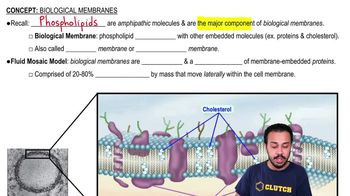
Biological Membranes Example 1
24405
views
454
rank
1
comments
06:04
Biological Membranes
33511
views
679
rank
2
comments
Termini in questo insieme (11)
Nascondere definizioni
Phospholipid bilayer structure
Composed of hydrophilic heads facing outward and hydrophobic tails facing inward, forming a selective barrier.
Function of integral proteins
Span the membrane and assist in transport and communication across the membrane.
Role of peripheral proteins
Attach to the membrane surface and help with signaling and maintaining the cell's shape.
Transmembrane proteins
Proteins that extend across the membrane, facilitating transport and signal transduction.
Cholesterol in the membrane
Modulates membrane fluidity, making it less permeable to very small water-soluble molecules.
Glycoproteins and glycolipids function
Involved in cell recognition and signaling, important for immune response and cell communication.
Selective permeability of plasma membrane
Allows some substances to pass while blocking others, maintaining internal cell environment.
Components of the plasma membrane
Phospholipid bilayer, proteins, cholesterol, glycoproteins, and glycolipids.
Hydrophilic heads of phospholipids
Face the aqueous environments inside and outside the cell.
Hydrophobic tails of phospholipids
Face inward, away from water, creating a barrier to polar molecules.
Plasma membrane main function
Separates the cell from its environment and regulates substance movement.
 IndietroIndietro
 02:21