Skip to main content
General Biology
Il mio corso
Impara
Preparazione agli esami
AI Tutor
Guide di studio
Soluzioni per libri di testo
Flashcard
Esplora
Prova l'app
Il mio corso
Impara
Preparazione agli esami
AI Tutor
Guide di studio
Soluzioni per libri di testo
Flashcard
Esplora
Prova l'app
Indietro
Cell Membrane Structure and Transport
Puoi toccare per girare la carta.
Plasma membrane
Puoi toccare per girare la carta.
👆
Plasma membrane
Separates the living cell from its environment and is selectively permeable, allowing only certain substances to cross.
Avanzamenti del tracciato
I pulsanti di controllo sono stati cambiati in modalità "navigazione".
1/31
Video consigliati
02:21
Biological Membranes Example 1
24392
views
453
rank
1
comments
06:04
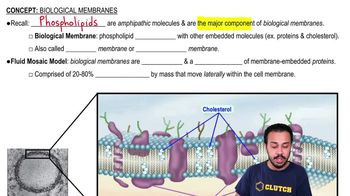
Biological Membranes
33490
views
679
rank
2
comments
Termini in questo insieme (31)
Nascondere definizioni
Plasma membrane
Separates the living cell from its environment and is selectively permeable, allowing only certain substances to cross.
Phospholipid bilayer
Composed of phospholipids with hydrophilic heads facing outward and hydrophobic tails facing inward, forming a barrier.
Amphipathic molecules
Molecules that have both hydrophobic and hydrophilic components, like phospholipids.
Fluid mosaic model
Describes the membrane as a fluid structure with a mosaic of proteins embedded within the phospholipid bilayer.
Membrane fluidity
Membrane molecules move laterally; fluidity is influenced by temperature and lipid composition.
Effect of temperature on membrane fluidity
Higher temperatures increase fluidity; lower temperatures cause phospholipids to pack tightly, reducing fluidity.
Role of unsaturated fatty acids in membranes
Kinks in unsaturated fatty acid tails prevent tight packing, increasing membrane fluidity.
Role of cholesterol in membrane fluidity
Acts as a fluidity buffer by preventing excessive movement at high temperatures and tight packing at low temperatures.
Integral membrane proteins
Penetrate the hydrophobic interior of the bilayer; transmembrane proteins span the entire membrane.
Peripheral proteins
Loosely bound to the membrane surface and do not penetrate the lipid bilayer.
Functions of membrane proteins
Include transport, enzymatic activity, signal transduction, cell recognition, intercellular joining, and attachment to cytoskeleton.
Membrane carbohydrates
Covalently bonded to lipids or proteins; important for cell-cell recognition and differentiation.
Selective permeability
Membrane allows some substances to cross while blocking others; hydrophobic molecules cross easily, hydrophilic do not.
Transport proteins
Help specific ions and molecules cross the membrane; include channel proteins and carrier proteins.
Passive transport
Diffusion of substances across membranes without energy input, moving down their concentration gradient.
Osmosis
Passive transport of water across a selectively permeable membrane from low to high solute concentration.
Tonicity
Ability of a solution to cause a cell to gain or lose water based on solute concentration relative to the cell.
Isotonic, hypertonic, hypotonic solutions
Isotonic: no net water movement; hypertonic: cell loses water; hypotonic: cell gains water and may burst.
Osmoregulation
Control of water balance in organisms to prevent damage from hypotonic or hypertonic environments.
Facilitated diffusion
Passive transport of molecules down their concentration gradient via specific transport proteins.
Gated channels
Ion channels that open or close in response to stimuli such as electrical, chemical, or physical signals.
Active transport
Energy-requiring process that moves substances against their concentration gradient using ATP.
Sodium-potassium pump
Active transport pump that moves 3 sodium ions out and 2 potassium ions into the cell, maintaining gradients.
Membrane potential
Voltage difference across a membrane, with the inside of the cell negative relative to the outside.
Electrochemical gradient
Combination of an ion's concentration gradient and membrane potential driving ion diffusion.
Electrogenic pumps
Pumps that generate voltage gradients across membranes, e.g., sodium-potassium pump and proton pumps.
Cotransport
Coupled transport where the movement of one solute down its gradient powers the active transport of another solute.
Endocytosis
Process by which cells engulf substances by forming vesicles from the plasma membrane.
Exocytosis
Process where vesicles fuse with the plasma membrane to release contents outside the cell.
Phagocytosis vs. pinocytosis
Phagocytosis is cellular eating of particles; pinocytosis is cellular drinking of fluids.
Receptor-mediated endocytosis
Selective uptake of specific molecules via receptors that bind ligands triggering vesicle formation.
 IndietroIndietro
 02:21