 Indietro
Cell Membrane Structure and Transport in General Biology
 02:21

Termini in questo insieme (14)
Substances cross a membrane without the cell using energy, moving down their concentration gradient.
The cell uses energy to move substances across a membrane, usually against their concentration gradient.
Proteins that help substances cross the cell membrane, facilitating movement of molecules.
The cell takes material in by surrounding it with its membrane and forming a vesicle.
A vesicle joins with the cell membrane to release material outside the cell.
Having both a part that attracts water (hydrophilic) and a part that avoids water (hydrophobic), like a phospholipid.
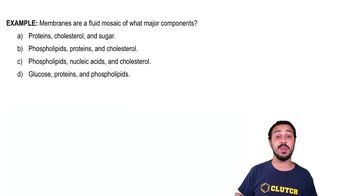
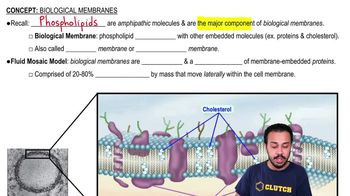
Describes the membrane as a flexible double layer of phospholipids with various proteins and molecules embedded that can move sideways.
A lipid that helps animal cell membranes stay flexible without becoming too fluid or too stiff.
How easily a substance can pass through a membrane.
Proteins attached to the membrane’s surface, not embedded inside it.
Proteins embedded within the membrane, often spanning part of it.
Proteins that extend all the way through the membrane, spanning both sides.
Lipids with carbohydrate chains attached that help cells recognize one another.
Proteins with carbohydrate chains attached that assist in cell recognition and signaling.