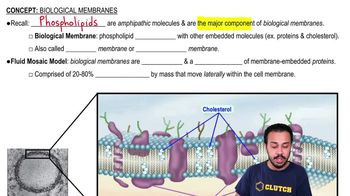
What is the Fluid Mosaic Model of the cell membrane?
The membrane is a fluid structure with a mosaic of various proteins embedded in or attached to a bilayer of amphipathic phospholipids.
What are the main components of the cell membrane?
Mainly amphipathic phospholipids forming a bilayer, with embedded proteins, cholesterol, and carbohydrates.
What does amphipathic mean in the context of phospholipids?
Having both hydrophilic (water-attracting) heads and hydrophobic (water-repelling) tails.
Why is membrane fluidity important?
It allows lipids and proteins to move sideways, enabling membrane flexibility, protein function, and cell signaling.
What types of proteins are found in the membrane mosaic?
Integral (including transmembrane) proteins and peripheral proteins.
What functions do membrane proteins perform?
Transport, enzymatic activity, signal transduction, cell-cell recognition, intercellular joining, and attachment to cytoskeleton and extracellular matrix.
What is selective permeability of the plasma membrane?
The membrane controls the exchange of substances, allowing some molecules to cross more easily than others.
Which molecules cross the membrane easily without transport proteins?
Hydrophobic (nonpolar) molecules like CO2 and O2.
How do hydrophilic (polar) molecules cross the membrane?
They generally require specific transport proteins such as channels or carriers.
What is diffusion in passive transport?
The movement of substances down their concentration gradient from high to low concentration without energy use.
What is osmosis?
The diffusion of water across a selectively permeable membrane from low to high solute concentration.
Define isotonic, hypotonic, and hypertonic solutions relative to a cell.
Isotonic: solute concentration equal inside and outside; Hypotonic: lower solute outside, water enters cell; Hypertonic: higher solute outside, water leaves cell.
What happens to animal cells in hypotonic solutions?
Water enters the cell, causing it to swell and possibly lyse.
How do plant cells respond to hypotonic solutions?
They swell until the cell wall exerts turgor pressure, preventing bursting.
What is facilitated diffusion?
Passive transport of molecules across the membrane via specific channel or carrier proteins.
How do channel proteins function?
They form hydrophilic channels that allow specific molecules or ions to pass through the membrane.
How do carrier proteins function in facilitated diffusion?
They change shape to transport specific solutes across the membrane.
What is active transport?
The movement of molecules against their concentration gradient using energy, often ATP.
Give an example of active transport in cells.
The sodium-potassium pump, which pumps sodium out and potassium into the cell using ATP.
What is cotransport?
A transport mechanism where a membrane protein couples the downhill diffusion of one solute to the uphill transport of another.
 Indietro
 02:21