Skip to main content
General Biology
Il mio corso
Impara
Preparazione agli esami
AI Tutor
Guide di studio
Soluzioni per libri di testo
Flashcard
Esplora
Prova l'app
Il mio corso
Impara
Preparazione agli esami
AI Tutor
Guide di studio
Soluzioni per libri di testo
Flashcard
Esplora
Prova l'app
Indietro
Cell Membranes and Transport - General Biology
Puoi toccare per girare la carta.
What is the fluid-mosaic model of the plasma membrane?
Puoi toccare per girare la carta.
👆
What is the fluid-mosaic model of the plasma membrane?
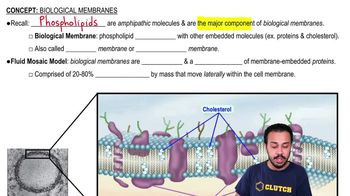
The plasma membrane is a semi-fluid, flexible bilayer of phospholipids with embedded proteins and molecules, creating a mosaic of components.
Avanzamenti del tracciato
I pulsanti di controllo sono stati cambiati in modalità "navigazione".
1/21
Video consigliati
02:21
Biological Membranes Example 1
24599
views
457
rank
1
comments
06:04
Biological Membranes
33727
views
684
rank
2
comments
Termini in questo insieme (21)
Nascondere definizioni
What is the fluid-mosaic model of the plasma membrane?
The plasma membrane is a semi-fluid, flexible bilayer of phospholipids with embedded proteins and molecules, creating a mosaic of components.
What does it mean that the plasma membrane is semi-permeable?
It selectively allows certain molecules to cross in or out, regulating the cell's internal environment.
What are the main components of the plasma membrane?
Phospholipids, proteins, carbohydrates, and sterols (cholesterol in animal cells).
Describe the structure of a phospholipid.
A phospholipid has two unsaturated fatty acid tails (hydrophobic) and a phosphate-containing polar head (hydrophilic), making it amphipathic.
What role does cholesterol play in the plasma membrane?
Cholesterol reduces membrane fluidity, acts as antifreeze in cold, and is involved in transport, signaling, and hormone synthesis.
What is the function of carbohydrates in the cell membrane?
They increase cell specificity, help cells stick together to form tissues, and assist in cell recognition.
What is passive transport?
Movement of substances from high to low concentration without energy input, down the concentration gradient.
Name the types of passive transport.
Simple diffusion, osmosis, and facilitated diffusion.
What is simple diffusion?
Movement of small non-polar molecules like O2 and CO2 directly through the phospholipid bilayer.
What is osmosis?
The simple diffusion of water molecules across a semi-permeable membrane.
What is facilitated diffusion?
Diffusion of molecules through a protein channel or carrier, assisting molecules that cannot cross the bilayer directly.
What is active transport?
Movement of molecules against their concentration gradient using energy from ATP.
Name three types of energy-requiring transport.
Active transport, exocytosis, and endocytosis.
What is exocytosis?
The process of moving large molecules or groups of molecules out of the cell via vesicles, requiring ATP.
What is endocytosis?
The process of taking large molecules or groups of molecules into the cell via vesicles, requiring ATP.
List and describe the three types of endocytosis.
Pinocytosis (cell drinking), phagocytosis (cell eating), and receptor-mediated endocytosis (selective uptake using receptors).
What are transport proteins?
Proteins that form hydrophilic channels allowing specific ions or molecules to cross the membrane, often using active transport.
What are receptor site proteins?
Proteins that bind specific chemicals (ligands) to trigger a response or transport across the membrane.
What is the role of cell adhesion proteins?
They help cells stick together to form tissues and regulate cell-to-cell communication.
What do cell recognition proteins do?
They act as surface markers (glycoproteins) that distinguish species, individuals, and cell types, important for immune response.
Define tonicity and its types.
Tonicity indicates water movement direction: hypertonic (water leaves cell), hypotonic (water enters cell), isotonic (no net water movement).
 IndietroIndietro
 02:21