Indietro

Cell Signaling and Metabolism in General Biology

I pulsanti di controllo sono stati cambiati in modalità "navigazione".
1/21
  • What is cell signaling?

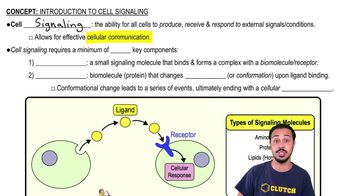
    Cell signaling is the process by which cells detect and respond to external signals, enabling communication and coordination of cellular activities.
  • What are the three stages of cell signaling?

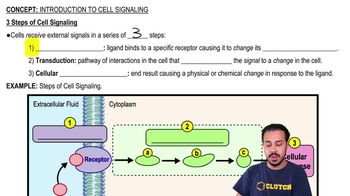
    1. Reception: target cell detects a signaling molecule.
    2. Transduction: signal is converted into a form that triggers a cellular response.
    3. Response: specific cellular activity is activated.
  • What is the difference between local and long-distance signaling?

    Local signaling involves communication between nearby cells via direct contact or short-range messengers.
    Long-distance signaling uses hormones traveling through the bloodstream to affect distant cells.
  • What are the main types of membrane receptors involved in cell signaling?

    1. G protein-coupled receptors (GPCRs)
    2. Receptor tyrosine kinases (RTKs)
    3. Ligand-gated ion channels
  • How do G protein-coupled receptors (GPCRs) function?

    GPCRs bind signaling molecules and activate a G protein by exchanging GDP for GTP, initiating a signal transduction pathway.
  • What role do receptor tyrosine kinases (RTKs) play in signaling?

    RTKs catalyze the transfer of phosphate groups from ATP to tyrosine residues on proteins, triggering multiple signaling pathways.
  • How do ligand-gated ion channels work?

    They open or close in response to a signaling molecule binding, allowing specific ions to pass through the membrane and alter cell activity.
  • What are intracellular receptors and how do they function?

    Intracellular receptors are found inside the cell and bind small or hydrophobic messengers like steroid hormones, often acting as transcription factors.
  • What is metabolism?

    Metabolism is the totality of an organism's chemical reactions, including catabolic and anabolic pathways.
  • What is the difference between catabolic and anabolic pathways?

    Catabolic pathways release energy by breaking down molecules.
    Anabolic pathways consume energy to build complex molecules.
  • What are the first and second laws of thermodynamics in biological context?

    1. Energy cannot be created or destroyed, only transformed.
    2. Every energy transfer increases the entropy (disorder) of the universe.
  • Define free energy change (ΔG) and its significance.

    ΔG = ΔH – TΔS; it indicates if a reaction is spontaneous (ΔG < 0) or nonspontaneous (ΔG > 0).
  • What characterizes exergonic and endergonic reactions?

    Exergonic reactions release free energy (ΔG < 0) and occur spontaneously.
    Endergonic reactions absorb free energy (ΔG > 0) and are nonspontaneous.
  • Why do cells never reach metabolic equilibrium?

    Cells are open systems with constant material flow, preventing equilibrium and allowing continuous work.
  • What is ATP and its role in cellular work?

    ATP is a molecule with three phosphate groups that stores and transfers energy to drive chemical, transport, and mechanical work.
  • How is energy released from ATP?

    Energy is released when the terminal phosphate bond is hydrolyzed, converting ATP to ADP and inorganic phosphate.
  • What is an enzyme and how does it function?

    An enzyme is a protein catalyst that speeds up specific reactions by lowering activation energy without being consumed.
  • What is activation energy (EA)?

    The initial energy required to break bonds and start a chemical reaction.
  • How do enzymes lower activation energy?

    By orienting substrates, stretching bonds, providing favorable microenvironments, and participating chemically in reactions.
  • What is allosteric regulation?

    Regulation where a molecule binds a protein at one site and affects function at another, either inhibiting or stimulating enzyme activity.
  • What is feedback inhibition?

    A metabolic pathway is shut down by its end product to prevent wasteful overproduction.