 Indietro
Cellular Respiration and Energy Harvesting in General Biology
 01:53

Termini in questo insieme (20)
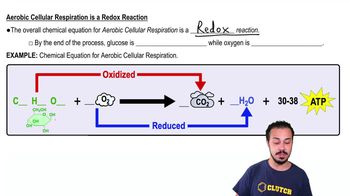
Cellular respiration breaks down organic molecules to produce ATP, capturing energy by converting glucose and oxygen into carbon dioxide, water, and energy.
Photosynthesis uses sunlight to produce organic molecules and oxygen, while cellular respiration consumes oxygen to break down those molecules, releasing energy as ATP.
Glucose + oxygen → carbon dioxide + water + energy (ATP)
Breathing supplies O2 needed for cellular respiration and removes CO2, a waste product of the process.
About 34% of the energy in glucose is captured as ATP; the rest is lost as heat.
Electrons are transferred from fuel molecules to NAD+, forming NADH, which passes them to the electron transport chain, releasing energy to make ATP.
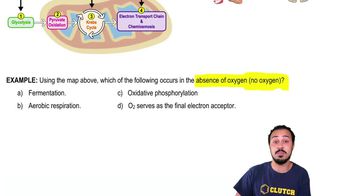
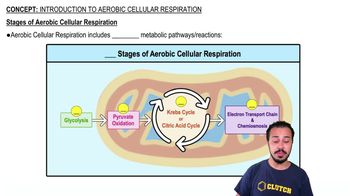
1. Glycolysis (cytosol)
2. Pyruvate oxidation and citric acid cycle (mitochondria)
3. Oxidative phosphorylation (mitochondria)
Glycolysis occurs in the cytosol and breaks glucose into two pyruvate molecules, producing a net of 2 ATP and 2 NADH.
Acetyl CoA is oxidized, releasing 2 CO2, producing 3 NADH, 1 FADH2, and 1 ATP per cycle turn.
Electrons from NADH and FADH2 pass through the electron transport chain, creating a proton gradient that drives ATP synthesis via ATP synthase.
Protons flow back through ATP synthase due to a gradient, powering the conversion of ADP to ATP.
Brown fat produces heat by allowing protons to flow freely across the mitochondrial membrane, dissipating the proton gradient without making ATP.
Up to 32 ATP molecules are produced by substrate-level and oxidative phosphorylation per glucose molecule.
Fermentation is an anaerobic process that produces ATP by glycolysis and recycles NAD+ by reducing pyruvate to lactate or alcohol.
Lactic acid fermentation (produces lactate) and alcohol fermentation (produces alcohol and CO2).
It occurs in the cytosol of nearly all organisms and does not require oxygen, indicating early evolution in prokaryotes.
Cells can use carbohydrates, fats, and proteins as fuel to produce ATP.
Intermediates serve as raw materials for biosynthesis of other organic molecules, regulated by feedback inhibition.
ATP formation by transferring a phosphate group directly from an organic molecule to ADP during glycolysis and the citric acid cycle.
Glycolysis occurs in the cytosol, outside the mitochondria.