Mitochondria produce energy in the form of ATP through cellular respiration.
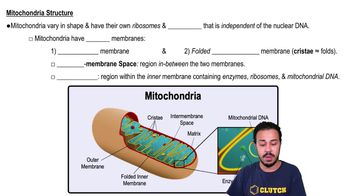
Describe the structure of the mitochondrial outer membrane.
The outer membrane is a lipid bilayer rich in proteins (50-60%) and porins, making it permeable to ions and molecules under 10 KDa.
What is the role of the intermembrane space in mitochondria?
It contains protons (H+) important for cellular respiration and cytochrome c molecules involved in apoptosis.
How does the inner mitochondrial membrane differ from the outer membrane?
The inner membrane has 80% proteins, low permeability, contains cristae, and hosts transporters and enzymatic complexes.
What components are found in the mitochondrial matrix?
The matrix contains mito-ribosomes, circular DNA, mRNA, tRNA, and enzymes for pyruvate oxidation, fatty acid oxidation, and the citric acid cycle.
What is unique about mitochondrial DNA (mtDNA)?
mtDNA is circular, lacks histones, has a slightly different genetic code, is maternally inherited, and exists in 5-10 copies per mitochondrion.
What is mitochondrial biogenesis?
The process of forming new mitochondria from pre-existing ones, involving fusion and fission to maintain mitochondrial function.
Define catabolic pathways in cellular respiration.
Catabolic pathways break down organic molecules, releasing energy by oxidation to produce ATP.
What is the difference between aerobic and anaerobic respiration?
Aerobic respiration uses O2 as the final electron acceptor, while anaerobic respiration uses other electronegative molecules.
Explain redox reactions in cellular respiration.
Redox reactions transfer electrons; oxidation is loss of electrons, reduction is gain. Electrons move from fuel molecules to electron carriers.
What role does NAD+ play in cellular respiration?
NAD+ acts as an electron acceptor, becoming NADH, which stores energy used later to synthesize ATP.
How does the electron transport chain function?
It passes electrons through protein complexes in the inner membrane, releasing energy to pump protons and ultimately reduce O2 to water.
What is chemiosmosis in mitochondria?
Chemiosmosis uses the proton gradient created by the electron transport chain to drive ATP synthesis via ATP synthase.
How many ATP molecules are produced per glucose molecule in cellular respiration?
Up to 32 ATP molecules are produced per glucose molecule through glycolysis, citric acid cycle, and oxidative phosphorylation.
What is substrate-level phosphorylation?
Direct synthesis of ATP by transferring a phosphate group from an organic substrate to ADP during glycolysis and the citric acid cycle.
Describe glycolysis.
Glycolysis breaks down glucose into two pyruvate molecules in the cytoplasm, producing 2 ATP and 2 NADH, and can occur with or without oxygen.
What happens to pyruvate before entering the citric acid cycle?
Pyruvate is oxidized to acetyl CoA by the pyruvate dehydrogenase complex, releasing CO2 and producing NADH.
Summarize the citric acid cycle.
The cycle oxidizes acetyl CoA to CO2 in the mitochondrial matrix, generating 1 ATP, 3 NADH, and 1 FADH2 per turn.
What is the proton-motive force?
The electrochemical gradient of protons across the inner mitochondrial membrane that drives ATP synthesis.
How do fermentation and anaerobic respiration differ from aerobic respiration?
Fermentation regenerates NAD+ without an electron transport chain; anaerobic respiration uses electron acceptors other than O2; aerobic respiration uses O2.
Name two common types of fermentation.
Alcohol fermentation (produces ethanol and CO2) and lactic acid fermentation (produces lactate without CO2).
Why is NAD+ regeneration important in fermentation?
It allows glycolysis to continue by accepting electrons, enabling ATP production without oxygen.
What is the net ATP yield of fermentation per glucose molecule?
Fermentation yields 2 ATP per glucose molecule via substrate-level phosphorylation.
How is ATP synthase powered?
ATP synthase is powered by the flow of protons down their gradient through the enzyme, synthesizing ATP from ADP and phosphate.
 Indietro
 03:16