A metabolic pathway that releases stored energy by breaking down complex molecules; fermentation and cellular respiration harvest energy from organic fuels.
Fermentation
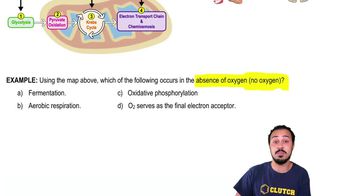
Partial degradation of sugars generating ATP without oxygen or an electron transport chain; relies on glycolysis and regenerates NAD⁺.
Cellular respiration
Catabolic pathways consuming oxygen and organic fuel to generate ATP using an electron transport chain; includes aerobic and anaerobic forms.
Aerobic respiration
Cellular respiration using oxygen as the final electron acceptor in the electron transport chain.
Anaerobic respiration
Cellular respiration using an electron transport chain with a final electron acceptor other than oxygen, such as sulfate.
Summary equation for cellular respiration
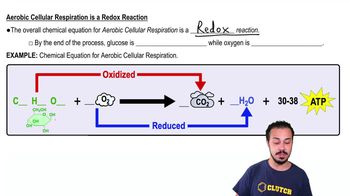
C₆H₁₂O₆ + 6 O₂ → 6 CO₂ + 6 H₂O + energy (ATP + heat); glucose degradation is exergonic with ΔG = −686 kcal/mol.
Redox reaction
A chemical reaction involving electron transfer from one reactant to another; short for oxidation-reduction reaction.
Oxidation
Loss of electrons from a substance; in organic molecules, often the loss of hydrogen atoms.
Reduction
Gain of electrons by a substance; often adds hydrogen atoms to an organic molecule.
Reducing agent
The electron donor in a redox reaction; it becomes oxidized.
Oxidizing agent
The electron acceptor in a redox reaction; it becomes reduced. Oxygen is a strong oxidizing agent.
NAD⁺ (nicotinamide adenine dinucleotide)
A coenzyme that acts as an oxidizing agent by accepting electrons and is reduced to NADH.
NADH
The reduced form of NAD⁺; stores energy as high-energy electrons delivered to the electron transport chain.
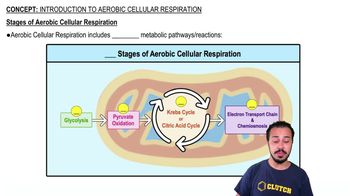
Electron transport chain
Series of electron carriers in the inner mitochondrial membrane that pass electrons in redox steps, releasing energy gradually.
Oxidative phosphorylation
Production of ATP using energy from redox reactions of the electron transport chain; accounts for most ATP in respiration.
Substrate-level phosphorylation
Enzymatic transfer of a phosphate group from a substrate directly to ADP, forming ATP; occurs in glycolysis and citric acid cycle.
Glycolysis
Pathway splitting glucose into two pyruvate molecules; occurs in cytosol, does not require oxygen, starts fermentation and respiration.
Pyruvate oxidation
Conversion of pyruvate to acetyl CoA in mitochondria, releasing CO₂ and reducing NAD⁺ to NADH.
Citric acid cycle (Krebs cycle)
Mitochondrial cycle oxidizing acetyl CoA to CO₂, producing NADH, FADH₂, and ATP; regenerates oxaloacetate each turn.
ATP synthase
Enzyme complex in inner mitochondrial membrane that synthesizes ATP from ADP and phosphate using H⁺ flow down its gradient.
Proton gradient (H⁺ gradient)
Difference in proton concentration across inner mitochondrial membrane; stores potential energy used to make ATP.
Chemiosmosis
Energy-coupling mechanism using H⁺ gradient energy to drive ATP synthesis during oxidative phosphorylation.
Alcohol fermentation
Fermentation converting pyruvate to ethanol via acetaldehyde, releasing CO₂ and regenerating NAD⁺.
Lactic acid fermentation
Fermentation reducing pyruvate directly to lactate, regenerating NAD⁺ without releasing CO₂; occurs in some bacteria and muscle cells.
Facultative anaerobe
Organism that can switch between aerobic respiration and fermentation depending on oxygen availability.
Beta oxidation
Metabolic process breaking fatty acids into two-carbon fragments that enter the citric acid cycle as acetyl CoA.
Phosphofructokinase (PFK)
Allosteric enzyme catalyzing a key early step in glycolysis; regulated by ATP, AMP, and citrate to control respiration rate.
Efficiency of respiration
About 34% of glucose energy is transferred to ATP; the rest is lost as heat.
 Indietro
 01:53