Skip to main content
General Biology
Il mio corso
Impara
Preparazione agli esami
AI Tutor
Guide di studio
Soluzioni per libri di testo
Flashcard
Esplora
Prova l'app
Il mio corso
Impara
Preparazione agli esami
AI Tutor
Guide di studio
Soluzioni per libri di testo
Flashcard
Esplora
Prova l'app
Indietro
Cellular Respiration and Photosynthesis- lecture 7a-chapter 9(exam 2)
Puoi toccare per girare la carta.
What are the chemical ingredients for photosynthesis?
Puoi toccare per girare la carta.
👆
What are the chemical ingredients for photosynthesis?
CO2
from air and
H2O
absorbed from soil are used by chloroplasts with light energy to produce glucose and oxygen.
Avanzamenti del tracciato
I pulsanti di controllo sono stati cambiati in modalità "navigazione".
1/20
Video consigliati
03:32
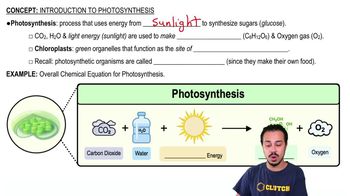
Introduction to Photosynthesis
21141
views
425
rank
07:55
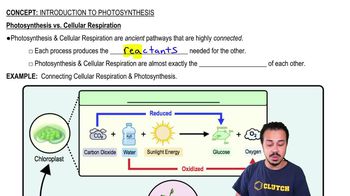
Photosynthesis vs. Cellular Respiration
16846
views
220
rank
03:20
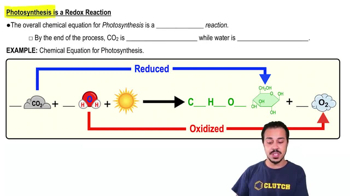
Photosynthesis is a Redox Reaction
1915
views
45
rank
Termini in questo insieme (20)
Nascondere definizioni
What are the chemical ingredients for photosynthesis?
CO2
from air and
H2O
absorbed from soil are used by chloroplasts with light energy to produce glucose and oxygen.
What is the byproduct of photosynthesis?
Oxygen (O2)
is released as a byproduct during photosynthesis.
What does cellular respiration use and produce?
Cellular respiration uses
O2
and organic molecules to produce
ATP
,
CO2
, and
H2O
.
Define autotrophs and give examples.
Autotrophs
make organic matter from inorganic nutrients like CO2 and water. Examples:
plants
and
algae
.
Define heterotrophs and give examples.
Heterotrophs
cannot make organic molecules from inorganic ones and obtain food by eating others. Examples:
humans
and
animals
.
What is the main goal of cellular respiration?
The goal is to generate
ATP
by breaking down glucose and oxygen into CO2 and H2O.
What type of reaction is cellular respiration?
Cellular respiration is a
redox reaction
where glucose is oxidized and oxygen is reduced.
What role does NAD+ play in cellular respiration?
NAD+
is a coenzyme that accepts electrons, becoming NADH, which stores energy for ATP synthesis.
What are the three main stages of cellular respiration?
1.
Glycolysis
, 2.
Citric Acid Cycle
, 3.
Electron Transport Chain
.
How is most ATP generated in cellular respiration?
Most ATP is generated by
oxidative phosphorylation
powered by redox reactions in the electron transport chain.
What happens during glycolysis?
Glucose (6-carbon) splits into two 3-carbon pyruvate molecules, producing a net gain of 2 ATP and 2 NADH.
What occurs in pyruvate oxidation?
Pyruvate loses a carbon as CO2, electrons transfer to NAD+ forming NADH, and acetic acid attaches to CoA forming acetyl-CoA.
What is the main function of the citric acid cycle?
It dismantles acetic acid to CO2, produces ATP directly, and captures energy in NADH and FADH2.
What is the electron transport chain's role?
It shuttles electrons, creates a proton gradient, and drives ATP synthesis by ATP synthase.
How does ATP synthase produce ATP?
ATP synthase uses the proton-motive force (H+ gradient) to convert ADP and inorganic phosphate into ATP.
What is feedback inhibition in cellular respiration?
If ATP levels drop, respiration speeds up; if ATP is high, respiration slows down to regulate energy production.
How are fats used in cellular respiration?
Fats are broken into glycerol and fatty acids; fatty acids undergo beta-oxidation to yield acetyl-CoA, NADH, and FADH2.
What is fermentation and its types?
Fermentation oxidizes NADH by transferring electrons to pyruvate or derivatives; types include
alcohol
and
lactic acid
fermentation.
What is the chemical equation for cellular respiration?
\(\mathrm{C_6H_{12}O_6 + 6O_2 \rightarrow 6CO_2 + 6H_2O + ATP}\)
What is substrate-level phosphorylation?
An enzyme transfers a phosphate group directly from a substrate to ADP to form ATP during glycolysis and the citric acid cycle.
 IndietroIndietro
 03:32