 Indietro
Cellular Respiration - General Biology
 01:53

Termini in questo insieme (34)
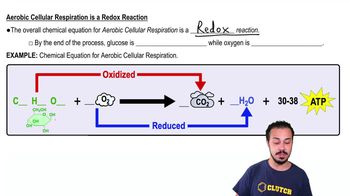
Glucose and oxygen are converted to carbon dioxide, water, and ATP. It is an exergonic reaction releasing energy.
Carbon dioxide is produced during the oxidation of pyruvate to acetyl-CoA and in the citric acid cycle inside the mitochondrial matrix.
Oxygen is the final electron acceptor in the electron transport chain, located in the inner mitochondrial membrane.
Oxidation is loss of electrons; reduction is gain of electrons.
Glucose is oxidized; oxygen is reduced to form water.
Loss of hydrogen atoms indicates oxidation; gain of hydrogen atoms indicates reduction.
To gradually release energy in manageable amounts and efficiently capture it as ATP rather than losing it as heat.
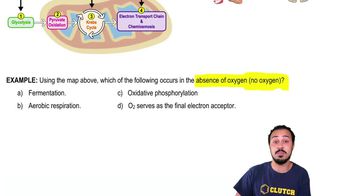
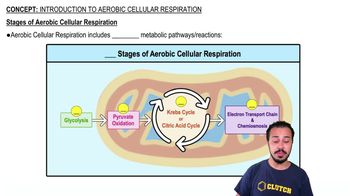
Glycolysis, Pyruvate oxidation, Citric acid cycle, and Oxidative phosphorylation.
Occurs in the cytoplasm in both eukaryotes and prokaryotes.
ATP provides activation energy to initiate the breakdown of glucose.
Inputs: glucose, 2 ATP, 2 NAD+; Outputs: 2 pyruvate, 4 ATP (net 2 ATP), 2 NADH.
NAD+ is reduced to NADH as glucose is oxidized.
In aerobic respiration, NADH donates electrons to the electron transport chain; in fermentation, NADH is oxidized back to NAD+ to allow glycolysis to continue.
Each pyruvate produces one molecule of carbon dioxide, one NADH, and one acetyl-CoA.
Occurs in the mitochondrial matrix.
Carbon dioxide, NADH, FADH2, and ATP (or GTP).
Because the starting molecule oxaloacetate is regenerated after each turn.
They shuttle electrons to the electron transport chain in their reduced forms and become oxidized back to NAD+ and FAD.
Embedded in the inner mitochondrial membrane.
To transfer electrons through protein complexes, releasing energy to pump protons and create a proton gradient.
Electrons come from NADH and FADH2; oxygen is the final electron acceptor forming water.
Electronegativity increases, electrons move to more electronegative carriers ending with oxygen.
It creates a proton gradient that drives ATP synthase to produce ATP via chemiosmosis.
The flow of protons down their electrochemical gradient through ATP synthase.
Substrates: ADP and inorganic phosphate; Product: ATP.
Oxidative phosphorylation produces the most ATP.
By uncoupling the proton gradient from ATP synthesis, releasing energy as heat.
A process that regenerates NAD+ by oxidizing NADH when oxygen is absent, allowing glycolysis to continue.
Alcohol fermentation produces ethanol and CO2; lactic acid fermentation produces lactate.
As acetyl-CoA after beta-oxidation, entering the citric acid cycle.
Fatty acids produce more ATP per gram, explaining why animals store energy as fat.
After deamination, amino acids enter as intermediates in glycolysis or the citric acid cycle.
It provides intermediates for amino acid synthesis and is regulated by feedback inhibition.
Phosphofructokinase is inhibited by ATP to regulate glycolysis based on energy needs.