Skip to main content
General Biology
Il mio corso
Impara
Preparazione agli esami
AI Tutor
Guide di studio
Soluzioni per libri di testo
Flashcard
Esplora
Prova l'app
Il mio corso
Impara
Preparazione agli esami
AI Tutor
Guide di studio
Soluzioni per libri di testo
Flashcard
Esplora
Prova l'app
Indietro
Cellular Respiration Processes in General Biology
Puoi toccare per girare la carta.
What is the main chemical change in glycolysis?
Puoi toccare per girare la carta.
👆
What is the main chemical change in glycolysis?
Glucose (C6H12O6) is partially oxidized into pyruvic acid (C3H4O3).
Avanzamenti del tracciato
I pulsanti di controllo sono stati cambiati in modalità "navigazione".
1/21
Video consigliati
01:53
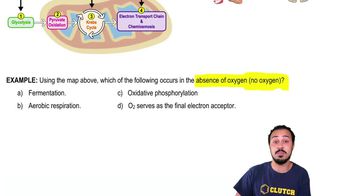
Introduction to Cellular Respiration Example 2
20125
views
234
rank
04:18
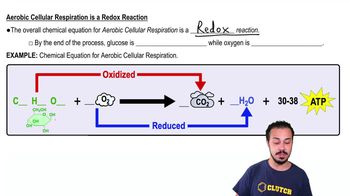
Aerobic Cellular Respiration is a Redox Reaction
31165
views
475
rank
02:31
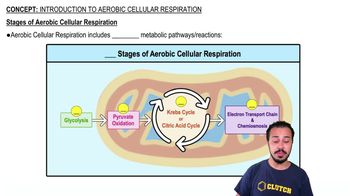
Stages of Aerobic Cellular Respiration
23766
views
361
rank
1
comments
Termini in questo insieme (21)
Nascondere definizioni
What is the main chemical change in glycolysis?
Glucose (C6H12O6) is partially oxidized into pyruvic acid (C3H4O3).
Where does glycolysis take place and does it require oxygen?
Glycolysis occurs in the cytosol and does not require oxygen.
What happens to NAD+ and NADH during glycolysis?
NAD+ is reduced to NADH + H+ during glycolysis.
What happens to ATP and ADP during glycolysis?
ATP is dephosphorylated to ADP, and ADP is phosphorylated to ATP, resulting in a net gain of 2 ATP.
What is the transition reaction in cellular respiration?
Pyruvic acid is oxidized into acetyl CoA in the mitochondrial matrix, reducing NAD+ to NADH.
Where does the transition reaction occur?
The transition reaction takes place in the mitochondrial matrix.
What are the products of the transition reaction per 2 pyruvic acid molecules?
2 Acetyl CoA, 2 CO2, and 2 NADH + 2H+.
What key processes occur in the Krebs cycle?
FAD is reduced to FADH2, NAD+ is reduced to NADH, and ADP is phosphorylated to ATP.
Where does the Krebs cycle take place?
The Krebs cycle occurs in the mitochondrial matrix.
What are the main products of the Krebs cycle per 2 acetyl CoA molecules?
4 CO2, 2 ATP, 2 FADH2, and 6 NADH + 6H+.
What happens in the Electron Transport System (ETS)?
Oxygen is reduced to water; NADH and FADH2 are oxidized; ADP is phosphorylated to ATP.
Where does the Electron Transport System take place?
ETS occurs in the mitochondrial cristae.
What is the role of oxygen in the ETS?
Oxygen acts as the final electron acceptor and is reduced to water.
How many ATP molecules are produced by the ETS?
The ETS produces 32 or 34 ATP molecules.
Which coenzymes are energy-rich electron carriers in cellular respiration?
NADH and FADH2 are energy-rich when reduced and carry electrons.
Which coenzymes are energy-poor and oxidized forms?
NAD+ and FAD are energy-poor oxidized forms and do not carry electrons.
In which stages is NAD+ reduced to NADH?
NAD+ is reduced in glycolysis, the transition reaction, and the Krebs cycle.
In which stage is FAD reduced to FADH2?
FAD is reduced to FADH2 in the Krebs cycle.
Where are NADH and FADH2 oxidized back to NAD+ and FAD?
NADH and FADH2 are oxidized in the Electron Transport System.
What is the net ATP gain from glycolysis?
The net gain is 2 ATP molecules per glucose molecule.
What molecules are produced as waste during the transition reaction and Krebs cycle?
Carbon dioxide (CO2) is produced as a waste product.
 IndietroIndietro
 01:53