Skip to main content
General Biology
Il mio corso
Impara
Preparazione agli esami
AI Tutor
Guide di studio
Soluzioni per libri di testo
Flashcard
Esplora
Prova l'app
Il mio corso
Impara
Preparazione agli esami
AI Tutor
Guide di studio
Soluzioni per libri di testo
Flashcard
Esplora
Prova l'app
Indietro
ch.26
Puoi toccare per girare la carta.
What is a phylogenetic tree?
Puoi toccare per girare la carta.
👆
What is a phylogenetic tree?
A diagram that represents evolutionary relationships among species based on shared characteristics or genetic information.
Avanzamenti del tracciato
I pulsanti di controllo sono stati cambiati in modalità "navigazione".
1/23
Video consigliati
VideoThumbView.guidedCourse
02:32
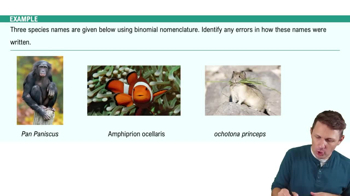
Binomial Nomenclature
3245
views
43
rank
VideoThumbView.guidedCourse
06:57
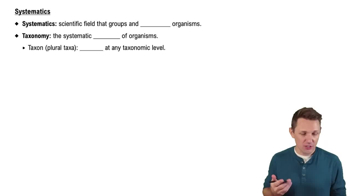
Systematics
3962
views
78
rank
VideoThumbView.guidedCourse
01:31
Introduction to Phylogeny Example 1
2764
views
31
rank
Termini in questo insieme (23)
Nascondere definizioni
What is a phylogenetic tree?
A diagram that represents evolutionary relationships among species based on shared characteristics or genetic information.
Why can phylogenetic trees be revised?
Because they are based on current information, and new data or methods can change our understanding of evolutionary relationships.
Define a monophyletic group.
A group consisting of an ancestor and all of its descendants; preferred in taxonomy for reflecting true evolutionary history.
What is a paraphyletic group?
A group containing an ancestor and some, but not all, of its descendants.
What is a polyphyletic group?
A group composed of unrelated organisms descended from more than one ancestor.
Why are monophyletic groups preferred in taxonomy?
Because they accurately represent evolutionary lineages and shared common ancestry.
What is the principle of parsimony in phylogenetics?
Choosing the tree that requires the fewest evolutionary changes or steps.
How can neutral mutations spread through populations?
Through genetic drift, where mutations neither benefit nor harm the organism but can become common by chance.
What is a molecular clock?
A method that uses the rate of genetic mutations to estimate the time since two species diverged.
How can horizontal gene transfer complicate phylogenetic trees?
It introduces genes between unrelated species, obscuring true evolutionary relationships.
How does convergent evolution affect phylogenetic analysis?
It causes unrelated species to develop similar traits, which can be mistaken for shared ancestry.
Describe the binomial nomenclature system.
A two-part naming system for species using genus and species names, e.g.,
Homo sapiens
.
What is the hierarchy of taxonomic grouping?
Domain, Kingdom, Phylum, Class, Order, Family, Genus, Species.
Define phylogeny.
The evolutionary history and relationships among species or groups of organisms.
What is systematics?
The study of biological diversity and evolutionary relationships.
Define taxon.
A named group of organisms at any level of the taxonomic hierarchy.
What are sister taxa?
Two groups that share an immediate common ancestor.
Define analogy in evolutionary biology.
Similarity in traits due to convergent evolution, not common ancestry.
Define homology.
Similarity in traits due to shared ancestry.
What is a clade?
A group consisting of an ancestor and all its descendants; a monophyletic group.
What is a shared ancestral character?
A trait shared by a group of organisms inherited from a distant common ancestor.
What is a shared derived character?
A trait that evolved in the most recent common ancestor and is unique to a particular clade.
Define homoplasy.
A trait that appears similar in different species but is not due to common ancestry, often from convergent evolution.
 IndietroIndietro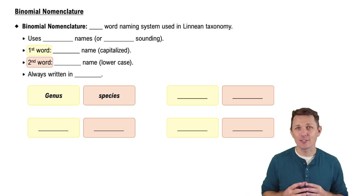
 02:32
02:32