 Indietro
Chapter 2 lecture 1
 02:13
02:13
Termini in questo insieme (20)
An element is a substance that cannot be broken down into other substances by ordinary chemical means.
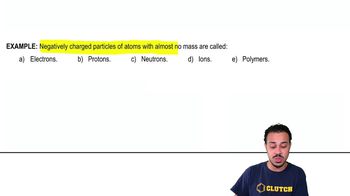
Protons (positive charge), neutrons (no charge), and electrons (negative charge).
The atomic number is the number of protons in an atom and equals the number of electrons in a neutral atom.
The mass number is the sum of protons and neutrons in the nucleus.
Isotopes are atoms of the same element with different mass numbers due to varying numbers of neutrons.
Carbon-13 has 6 protons and 7 neutrons (13 - 6 = 7 neutrons).
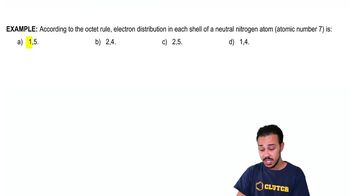
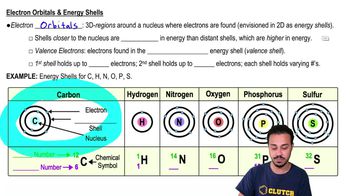
Electrons fill shells starting from the closest to the nucleus: 1st shell holds 2 electrons, 2nd shell holds 8, 3rd shell holds 18 but is stable with 8.
The valence shell is the outermost electron shell of an atom, important for chemical bonding.
Oxygen has 8 protons, 8 electrons, and 6 electrons in its valence shell.
Carbon has 6 protons, 6 electrons, and 4 electrons in its valence shell.
Oxygen makes up approximately 65% of the human body.
Oxygen (65%), Carbon (18.5%), Hydrogen (9.5%), Nitrogen (3.3%).
Protons have a positive charge and are located in the nucleus.
Neutrons have no charge and are located in the nucleus.
Electrons have a negative charge and orbit the nucleus in the electron cloud.
The first electron shell can hold up to 2 electrons.
The second electron shell can hold up to 8 electrons.
The third shell can hold up to 18 electrons but is stable with 8 electrons.
Carbon-12 has an atomic number of 6 and a mass number of 12.
They differ in neutrons: Carbon-12 has 6, Carbon-13 has 7, Carbon-14 has 8 neutrons.