Skip to main content
General Biology
Il mio corso
Impara
Preparazione agli esami
AI Tutor
Guide di studio
Soluzioni per libri di testo
Flashcard
Esplora
Prova l'app
Il mio corso
Impara
Preparazione agli esami
AI Tutor
Guide di studio
Soluzioni per libri di testo
Flashcard
Esplora
Prova l'app
Indietro
CHAPTER 3 Biology in Focus
Puoi toccare per girare la carta.
What is an organic compound?
Puoi toccare per girare la carta.
👆
What is an organic compound?
A compound containing
carbon
, which is the basis of most molecules in living organisms.
Avanzamenti del tracciato
I pulsanti di controllo sono stati cambiati in modalità "navigazione".
1/29
Video consigliati
03:35
Carbon is an Excellent Building Block
22667
views
903
rank
04:19
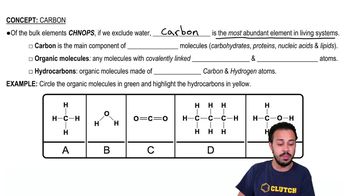
Carbon
29849
views
706
rank
2
comments
Termini in questo insieme (29)
Nascondere definizioni
What is an organic compound?
A compound containing
carbon
, which is the basis of most molecules in living organisms.
Name the four main classes of important biological molecules.
Carbohydrates, lipids, proteins,
and
nucleic acids
.
What is a polymer?
A long molecule consisting of many similar building blocks called
monomers
.
What reaction links monomers to form polymers?
A
dehydration reaction
, which removes a water molecule to form a covalent bond.
What reaction breaks down polymers into monomers?
Hydrolysis
, which adds a water molecule to break covalent bonds.
What are monosaccharides?
The simplest carbohydrates or
simple sugars
, usually with molecular formulas that are multiples of CH2O.
What is a glycosidic linkage?
A covalent bond formed between two monosaccharides during a dehydration reaction to form a disaccharide.
What determines the structure and function of a polysaccharide?
The type of sugar monomers and the positions of
glycosidic linkages
.
What is the main storage polysaccharide in plants?
Starch
, composed entirely of glucose monomers.
What is glycogen?
A storage polysaccharide in animals, mainly stored in liver and muscle cells.
What is cellulose and its role?
A structural polysaccharide that is a major component of plant cell walls.
What are lipids characterized by?
Having little or no affinity for water; they are
hydrophobic
due to mostly hydrocarbon content.
What are fats made of?
Glycerol and three fatty acids joined by
ester linkages
to form triacylglycerols.
Difference between saturated and unsaturated fatty acids?
Saturated fatty acids have no double bonds and maximum hydrogens; unsaturated have one or more double bonds causing kinks.
What is the major function of fats?
Energy storage; fats store more energy per gram than carbohydrates.
Describe the structure of phospholipids.
Two fatty acid tails (hydrophobic) and a phosphate group head (hydrophilic) attached to glycerol.
What are steroids?
Lipids characterized by a carbon skeleton of four fused rings; cholesterol is a key example.
What are proteins and their general functions?
Polymers of amino acids with diverse functions including enzymatic catalysis, defense, transport, signaling, movement, and structural support.
What determines a protein's structure and function?
The unique sequence of amino acids (primary structure) and the folding into 3D shapes.
Name the four levels of protein structure.
Primary (amino acid sequence), secondary (alpha helices and beta sheets), tertiary (3D folding), and quaternary (multiple polypeptides).
What causes sickle-cell disease at the molecular level?
A single amino acid substitution in hemoglobin's primary structure alters its shape and function.
What is denaturation?
Loss of a protein's native structure due to environmental changes, causing loss of function.
What are nucleic acids made of?
Polymers called polynucleotides made of monomers called nucleotides, each with a nitrogenous base, pentose sugar, and phosphate group.
Difference between DNA and RNA sugars?
DNA contains deoxyribose; RNA contains ribose.
What are the nitrogenous bases in DNA and RNA?
DNA: adenine, guanine, cytosine, thymine; RNA: adenine, guanine, cytosine, uracil.
How are nucleotides linked in nucleic acids?
By covalent bonds between the 3' hydroxyl of one sugar and the 5' phosphate of the next, forming a sugar-phosphate backbone.
Describe the structure of DNA.
Two antiparallel polynucleotide strands forming a double helix with complementary base pairing via hydrogen bonds.
What is genomics?
The study and comparison of whole genomes using bioinformatics tools.
What is proteomics?
The large-scale study and analysis of proteins.
 IndietroIndietro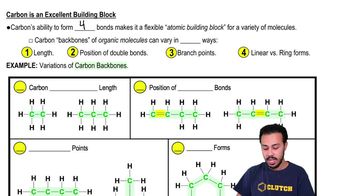
 03:35
03:35