 Indietro
Chapter 3 lecture part 2
 03:30
03:30
Termini in questo insieme (20)
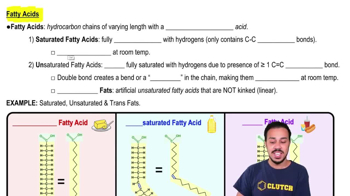
A fatty acid is a hydrocarbon chain with a carboxyl group at one end, varying in length and double bond location.
A triglyceride is a glycerol molecule joined to three fatty acids by ester linkages.
An ester linkage forms by a dehydration reaction joining fatty acids to glycerol.
Saturated fats have no double bonds and are solid at room temperature; unsaturated fats have one or more double bonds and are liquid.
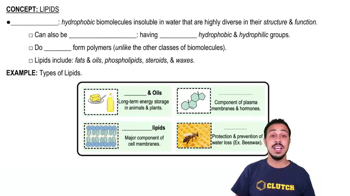
A phospholipid consists of glycerol joined to two fatty acids and a phosphate group, forming hydrophilic heads and hydrophobic tails.
Phospholipids form bilayers with hydrophilic heads facing water and hydrophobic tails facing inward.
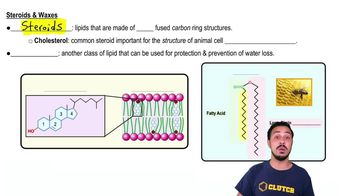
Steroids have a carbon skeleton of four fused rings; cholesterol is a common steroid in membranes.
Steroids are hydrophobic molecules.
Monomers: monosaccharides; Polymers: polysaccharides; linked by glycosidic bonds.
Monomers: amino acids; Polymers: polypeptides; linked by peptide bonds.
An amino acid has an amino group, a carboxyl group, a hydrogen, and a variable side chain (R group).
Side chains can be nonpolar (hydrophobic), polar (hydrophilic), acidic (negatively charged), or basic (positively charged).
A peptide bond is a covalent bond formed between the carboxyl group of one amino acid and the amino group of another via dehydration.
The sequence of amino acids determines how a protein folds and its final structure.
Denaturation is when a protein unravels, losing its shape and function due to environmental changes.
Proteins function in enzymes, transport, defense, structure, and movement.
Cholesterol stabilizes membrane fluidity and is a precursor to other steroids.
Hydrophilic heads are attracted to water; hydrophobic tails repel water.
The R group determines the amino acid's chemical properties and role in protein folding.
Acidic amino acids have negatively charged side chains; basic amino acids have positively charged side chains.